
BREAKING: Alberta Regulator Shuts Down Landowner's Ethics Complaint Without Investigation
Updated story for the Energy Mix - March 27, 2026, with images added

My Scottish/Irish ancestors were immigrants who travelled by ship to the east coast of so-called “Canada” in the late 1700’s or early 1800’s, and were part of several waves of genocidal colonization of the Indigenous people on Turtle Island. We arrived uninvited on the traditional unceded territory of the Wəlastəkewiyik (Maliseet) whose ancestors along with the Mi’Kmaq / Mi’kmaw and Passamaquoddy / Peskotomuhkati Tribes / Nations signed Peace and Friendship Treaties with the British Crown in the 1700s. Growing up, I knew little about the true history and we didn’t really discuss this in my family. As a child in the 1970’s, my parents moved west to work in the oil sands industry and I grew up in the Nistawâyâw (Cree) Ełídlį Kuę́ (Dene) - Fort McMurray area within Treaty 8 territory, which his home to six First Nations and six Métis communities. Today, I am grateful to be writing this newsletter from Moh’kinsstis, and the traditional Treaty 7 territory of the Blackfoot confederacy: Siksika, Kainai, Piikani, as well as the Îyâxe Nakoda and Tsuut’ina Nations. This territory is also home to the Métis Nation within Alberta (including Nose Hill Métis District 5 and Elbow Métis District 6). The Treaties were an agreement to share the land and must be honoured. I begin this newsletter with my personal past so that you may know a little about me and what motivates me to keep writing this newsletter in the present. As a grandmother, I choose to write freelance articles about energy and the environment out of concern for the future of my own and all grandkids. I support land back as an act of reconciliation. Lands inhabited by Indigenous peoples contain 80% of the world’s remaining biodiversity. Indigenous Peoples’ traditional knowledge systems are critical to creating a more harmonious future for all.
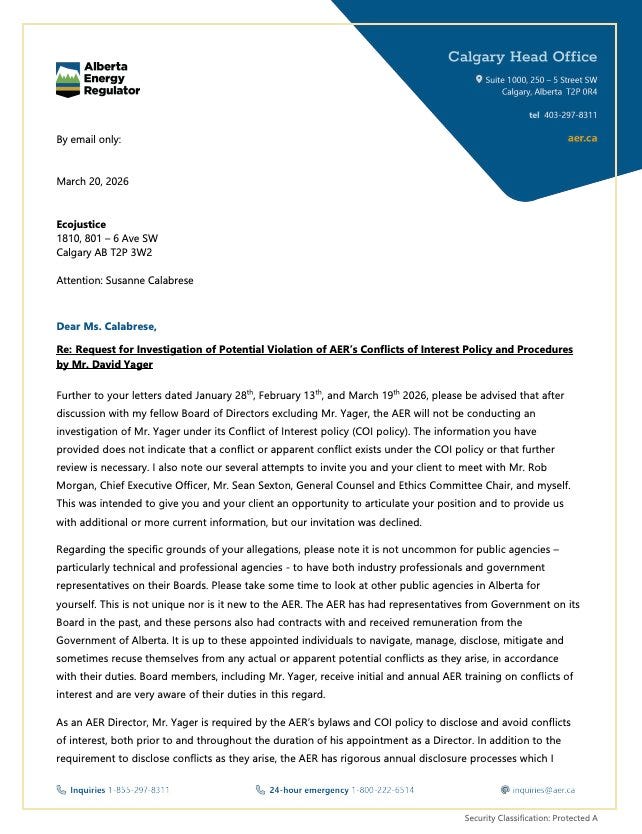
Alberta’s energy watchdog will not investigate board director David Yager for conflict of interest policy violations alleged by landowner Dwight Popowich. In a letter to Popowich’s lawyer Susanne Calabrese, Alberta Energy Regulator (AER) board chair Duncan Au wrote [pdf] that he and his fellow board directors were satisfied that no “conflict or apparent conflict” exists.
Yager simultaneously served as AER director, a special advisor to Premier Danielle Smith, and an industry consultant, while designing a strategy to deal with oil and gas liabilities.
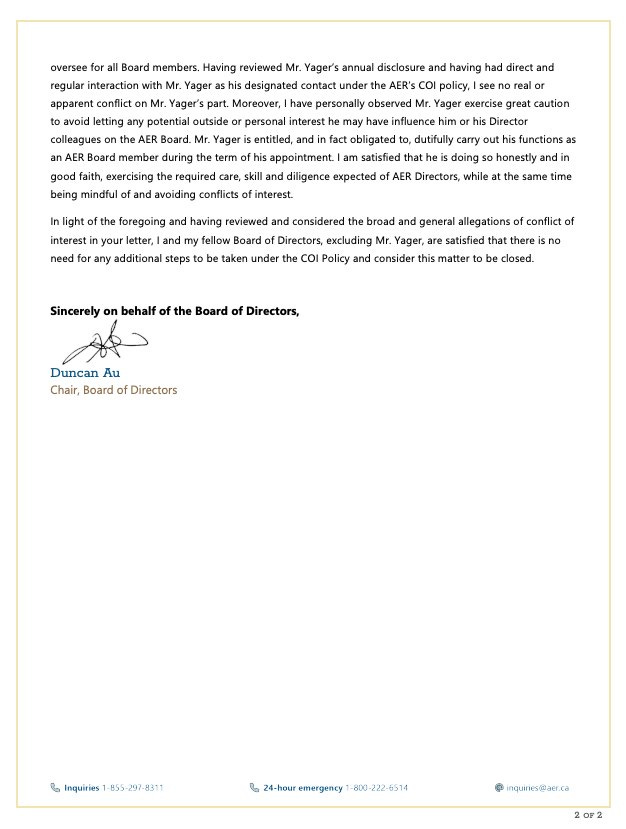
In the March 20 letter, Au cited several attempts to meet with Popowich to give him an opportunity to state his case, though Popowich and Calabrese claim Au demanded face to face meetings, with no written record, and no cell phones allowed. Au added he had observed Yager exercise great caution to “avoid letting any potential or outside or personal interest he may have, influence him or his director colleagues on the AER board.”
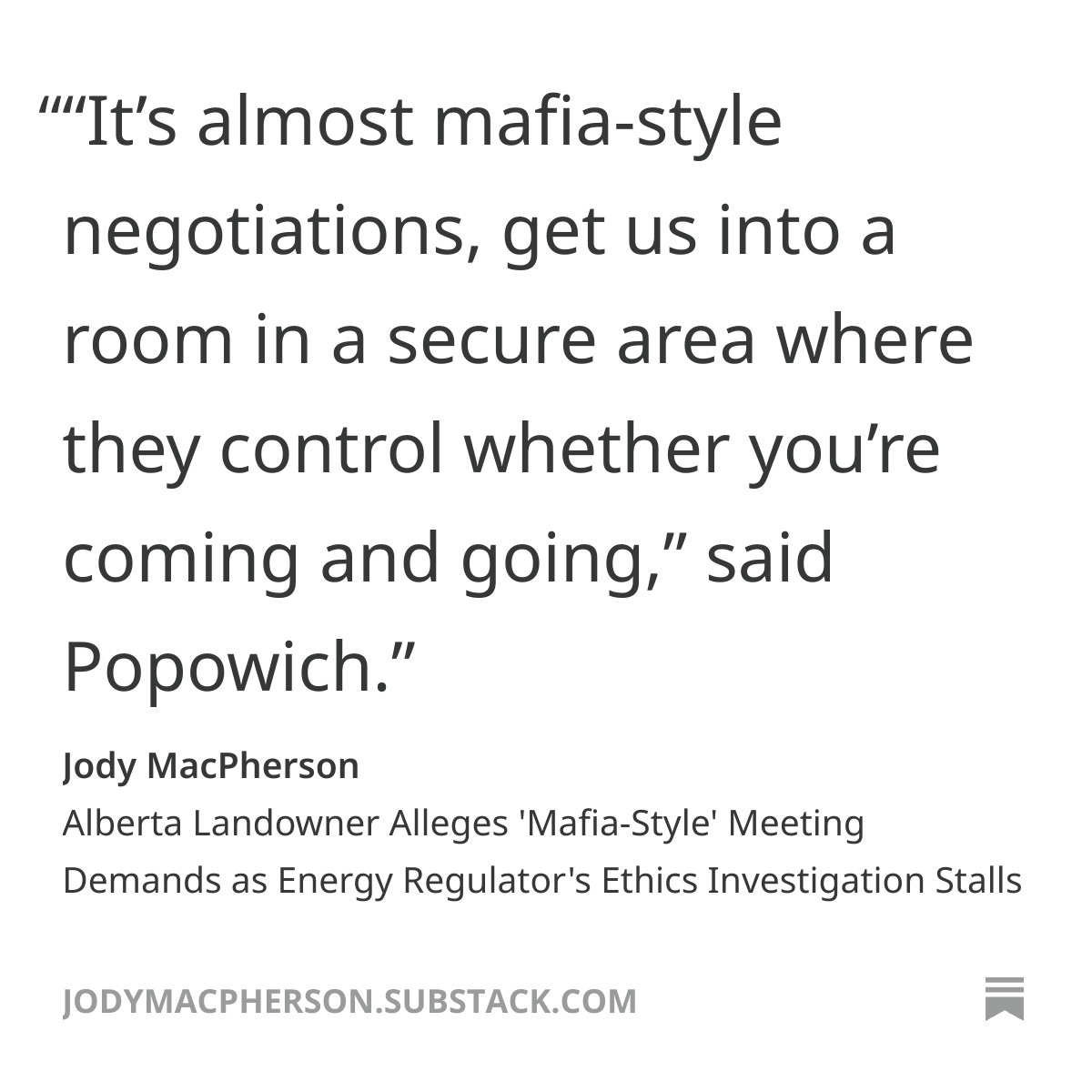
He said Yager is not the first board member to have contracts with or receive remuneration from the Alberta government while serving, and it is up to each individual “to navigate, manage, disclose, mitigate and sometimes recuse themselves from any actual or apparent potential conflicts as they arise.” The AER chair said he considers the matter closed. Popowich wrote in a statement to The Energy Mix that he followed the complaint process [pdf] in good faith only to be left without answers, saying “why not follow the rules and investigate to show transparency?”
Read the full story for the Energy Mix.
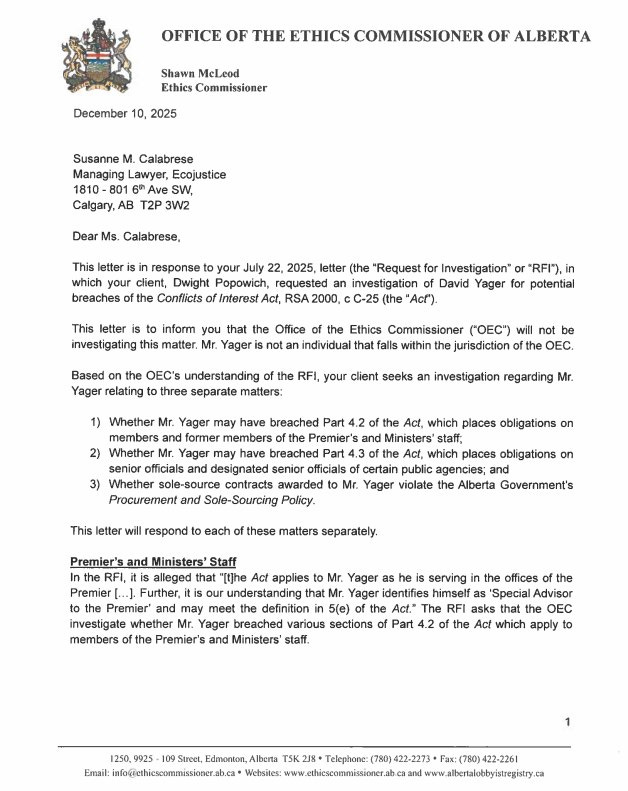
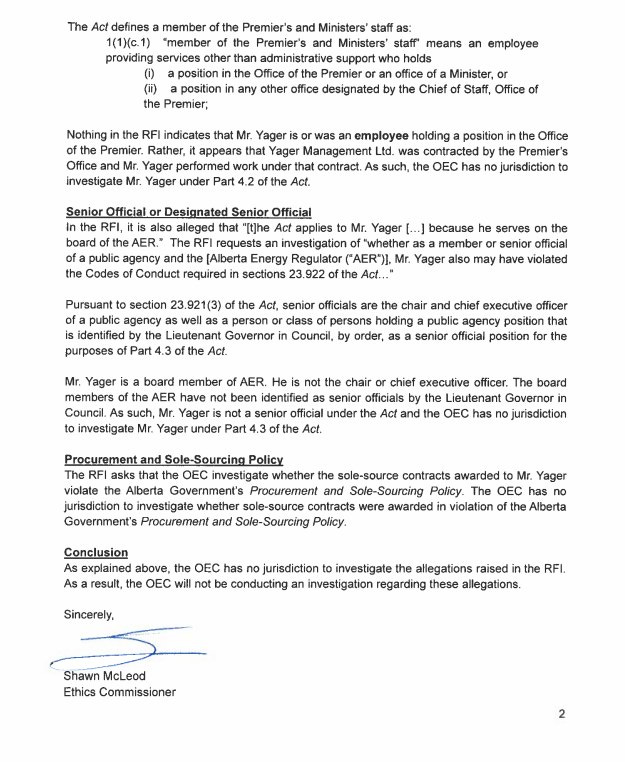
Copies of both the letters from Alberta’s Ethics Commissioner and the Alberta Energy Regulator relating to David Yager are reproduced at the end of this post.
Sorry state of ethics laws across the nation
As part of my research for this story, I interviewed Duff Conacher, co-founder of Democracy Watch, a Canadian non-profit, non-partisan organization advocating for democratic reform, government accountability and corporate responsibility.
We talked about the decision by Alberta’s Ethics Commissioner back in January that Yager was not covered by the province’s Conflict of Interest Act. Conacher said that the Act has a gap that doesn’t exist in similar legislation at the federal level, but is not unusual in provincial legislation across the country.
“All cabinet appointees are covered except for diplomats and judges…including the heads of every crown corporation (of which there’s not many any more), agencies boards, commissions and tribunals - about 140 people at the federal level.”
“And these laws don't get changed except based on crises, and scandals. So you just end up with a whole bunch of people who are not covered by any ethics rules, even though they are making decisions that are government decisions.
“That's usually what happens in the provinces. They have these internal codes which are enforced by the chair of the agency, board, commissioner, or tribunal and they just don't enforce it.”
Sound familiar? Conacher went on to explain these aspirational standards are “the only proper and meaningful standard” to maintain public confidence in government.
“Public confidence is based on perception because the public can't ever see what's going on internally. So they're always looking from the outside and perceiving whether the system has integrity based on limited information.“
“That's why the rule, the only effective rule is to say if there is an appearance of a conflict from the public's point of view, then you have to step aside, you can't participate if you allow for someone to participate when there is an appearance of a conflict interest, obviously the public would say that it smells.”
“But that's the situation across the country that you have conflict of interest laws that usually have huge loopholes. They really should be called ‘almost impossible to be in a conflict of interest’ laws.”
Problems across the political spectrum
You may be wondering how we can change these fatally flawed policies. Conacher says it is a difficult problem because politicians write the rules for themselves and their staff and hand-picked appointees.
“Parliament is sovereign in our constitution, federal parliament and all the provincial territorial legislatures, and they do write the rules and set up the enforcement system then the penalties.
“So unlike other areas where they're regulating someone else, they're regulating themselves, and across the political party spectrum they keep the public out. There's no one really to vote for if you're disappointed with what the ruling party's done because the other parties also are in favour of loopholes and weak enforcement systems and zero penalties for violating these laws.”
“None of them really care about the fact that that shatters the public trust in the political system because all they really care about is do we get enough votes to win the next election?”
Conacher said almost always after a crisis or scandal, the opposition party wants to distinguish itself from the ruling party, although they usually only do half of what they promise.
Systems are ‘a sad joke’ but politicians might bend to voter pressure
Nevertheless, he said Democracy Watch continues to “chip away” at the problem and is fundraising right now to strengthen Canada’s democracy and close loopholes that allow for government abuses to escape oversight. He’d like to be able to produce a report card rating for how the provinces and the federal government are performing in ethics and conflicts of interest.
“These systems are a sad joke. And they all have loopholes and weak enforcement systems and non-existent or very weak penalties. Much weaker than what politicians impose on Canadians under other laws for violations that are similarly serious like the lobbying law.
”In Alberta they’re ideologues in terms of certain issues. They’re also autocrats and they are trying to dismantle democratic safeguards. So it’s really hard to convince those people to do anything. It’s more a battle to try and stop them for making things worse.”
Conacher said unless they're “politically unintelligent” politicians almost always bend and make changes, so he recommended getting as many voters writing in as possible in order to bring about change.

Exemptions from conflict of interest laws are some of the biggest loopholes that need to be closed both federally and provincially, Conacher said.
“Looking at Alberta, the same exemptions are in there for the legislature, which is if you’re dealing with a matter of general application or that affects you as one of a broad class of the public, then you can’t be in a conflict of interest.
“Because 99% of decisions that are made by politicians and public officials apply generally or apply to a broad class of people or entities, And so the code does not apply 99% of the time.”
Conacher pointed to the hypothetical example of a senior official who regulates insurance companies. The official could own a million dollars worth of stock in that insurance company, while pushing for changes that would make all those companies more money. Because the official is changing law that applies generally, neither the Act nor the code apply.
Even the ethics committee had a gag order
Conacher recently testified (pdf) before a House of Commons committee hearing which was held behind closed doors, as an expert on ethics and conflicts of interest. Although they said he would not be allowed to talk about it, Conacher called it a “gag order” and that “it cannot be applied.”
“When I was talking about change to the code, they said if we change this code, would trust by the public increase from its dismal level, which is only about 20% of Canadians trust politicians, a consistent finding of surveys over the last 20 years.”
”And I said no, you’d have to follow the code. Changing the rules does not increase trust. I mean it will help a little bit, but the key is for people, everyone to follow it. They say, people should trust us, we’re here for the right reasons. I said ‘I’ve appeared before all the committees federally five or six times, and you’ve left the loopholes open.’”
”That allows for politicians and public officials to secretly profit from their own decisions. That allows for secret unethical lobbying, that allows for excessive secrecy overall in the Access to Information Act, that means whistleblowers are not really protected. And also a political finance system that essentially amounts to legalized bribery. And you are expecting high trust levels? Do you think voters are fools?”
For more on Democracy Watch’s work, check out their website at www.democracywatch.ca.
It’s the “No Kings” day of protest in the United States:
Read the full letter from the AER Board Chair:
Read the full letter from the Ethics Commissioner:
Thank you to Dwight Popowich, Susanne Calabrese and Duff Conacher for their contributions to this article.