
‘Dirty Data Centre Edition’: Big Tech Burning More Fossil Fuels Than Ever to Power AI
Written for The Energy Mix - May 12, 2026 - with bonus images, AI links and news

My Scottish/Irish ancestors were immigrants who travelled by ship to the east coast of so-called “Canada” in the late 1700’s or early 1800’s, and were part of several waves of genocidal colonization of the Indigenous people on Turtle Island. We arrived uninvited on the traditional unceded territory of the Wəlastəkewiyik (Maliseet) whose ancestors along with the Mi’Kmaq / Mi’kmaw and Passamaquoddy / Peskotomuhkati Tribes / Nations signed Peace and Friendship Treaties with the British Crown in the 1700s. Growing up, I knew little about the true history and we didn’t really discuss this in my family. As a child in the 1970’s, my parents moved west to work in the oil sands industry and I grew up in the Nistawâyâw (Cree) Ełídlį Kuę́ (Dene) - Fort McMurray area within Treaty 8 territory, which his home to six First Nations and six Métis communities. Today, I am grateful to be writing this newsletter from Moh’kinsstis, and the traditional Treaty 7 territory of the Blackfoot confederacy: Siksika, Kainai, Piikani, as well as the Îyâxe Nakoda and Tsuut’ina Nations. This territory is also home to the Métis Nation within Alberta (including Nose Hill Métis District 5 and Elbow Métis District 6). The Treaties were an agreement to share the land and must be honoured. I begin this newsletter with my personal past so that you may know a little about me and what motivates me to keep writing this newsletter in the present. As a grandmother, I choose to write freelance articles about energy and the environment out of concern for the future of my own and all grandkids. I support land back as an act of reconciliation. Lands inhabited by Indigenous peoples contain 80% of the world’s remaining biodiversity. Indigenous Peoples’ traditional knowledge systems are critical to creating a more harmonious future for all.
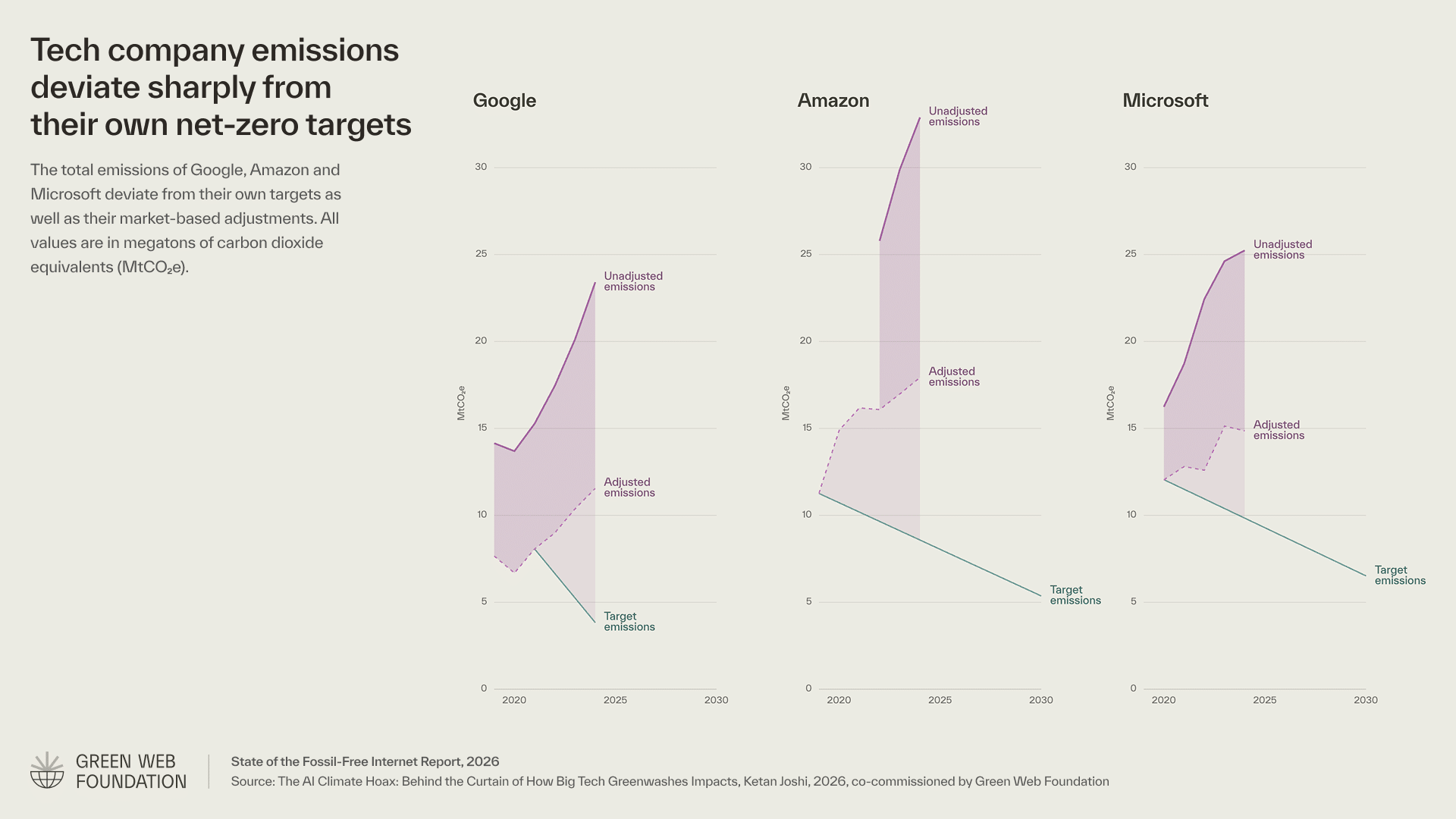
A new report says Big Tech companies including Amazon, Microsoft, and Google are relying on gas and diesel generators to power their hyperscale artificial intelligence data centres while burying data on the facilities’ true emissions and energy use.
Green Web Foundation, a non-profit campaigning for a fossil-free internet by 2030, drew on its own data and 140 other sources for its inaugural report, which it calls the “dirty data centre” edition. It finds that generative AI is jeopardizing the energy transition, demanding far more computing power than earlier AI models, and that the roughly 1,300 hyperscale data centres built to run it are increasingly turning to fossil fuels like gas and coal.
For example, Meta’s planned Hyperion data centre in Louisiana recently added seven more gas power plants to the three in its original plan—set to use as much electricity as the entire state of South Dakota, reported Tech Crunch.
Chris Adams, technology and policy director at the Green Web Foundation, told The Energy Mix that Google, Amazon, and Microsoft do not publicly disclose their energy use in a format that makes it possible to monitor or compare, but said “all three are burning more fossil fuels than ever.”
The three companies are responsible for more than half of all hyperscale AI data centres. Adams said the Green Web Foundation has created a scorecard to start tracking the issue and updating it annually. Other major operators are Meta, Alibaba, Tencent, Oracle, Apple, and ByteDance.
“We hope that when we publish the next State of the Fossil-Free Internet report, the data tells a different story,” he said.
A Pause on Data Centre Expansions
The groups behind the report are calling for “a pause on all data centre expansions until there is more accurate and granular data available locally and globally, and stronger measures in place to ensure that new data centres will not be powered by fossil fuels.”
Green Web recommends that “all claims about energy generation and use should be publicly accessible and independently verifiable,” since “the actions of just a few companies could theoretically make a huge difference to reducing the global emissions of the internet.”
The big tech culture of ‘‘move fast and break things” is operating at “previously unimagined speed and scale.”
Major tech companies are “driven by extractive capitalism,” Mike Gifford, open standards and practices lead for CivicActions, told The Mix. They are in “a race to get there first” and unwilling to wait until their business goals can be met sustainably.
The big tech culture of ‘‘move fast and break things” is operating at “previously unimagined speed and scale,” he added.
“Governments need to step up and start highlighting how AI can be harnessed to actually benefit society,” Gifford said. “That begins with ensuring that data centres do not destroy our communities.”

Not only are data centres not disclosing information, but when they do, “they fail to use a consistent open standard,” he said. That’s something Gifford and others have been advocating for.
“Data on energy consumption could be near real-time, and same with water consumption and noise pollution,” he explained. “The companies argue it could disclose trade secrets. However, this transparency should be ‘table stakes’ for this industry.”
Gifford said communities need to know projected values for energy, water, and noise, including for conditions such as heat waves and drought. “Citizens need to know the full expected cost before these data centres are built,” including their contracts with local governments and energy providers.
Industry Claims: 74% Unproven
Another report released in February, authored by climate and energy analyst Ketan Joshi, found that 74% of industry claims about AI’s climate benefits are unproven. Green Web Foundation was one of a consortium of environmental organizations that commissioned the study.
“It appears tech companies are using vagueness about what happens within energy-hogging data centres to greenwash a planet-wrecking expansion.”
The report found that Google and Microsoft, along with institutions such as the International Energy Agency, claimed AI would result in a “net climate benefit”. But that conclusion did not hold up under scrutiny. A review of 154 statements making the claim found only 26% cited published academic papers, and 36% did not cite any evidence at all.

“It appears tech companies are using vagueness about what happens within energy-hogging data centres to greenwash a planet-wrecking expansion,” Joshi said in a news release. “The promises of planet-saving tech remain hollow, while AI data centres breathe life into coal and gas every day.”
Nathan Taft, senior campaigner with Stand.earth, one of the groups that commissioned the February study, told The Mix that “there is a right way to do it, but we’re not seeing that from hardly anybody.”
Communities “need to take a real hard look at the data centres that are coming in, and make sure that they’re getting proper benefits, that the company’s paying its taxes, they’re not adding to the pollution burden, they have a plan for water, and they have the community partnership locked in from the beginning,” he said.

A ‘Big Red Flag’
Taft added that “it’s a big red flag” when tech companies demand non-disclosure agreements and residents are kept in the dark.
“Ultimately, it’s the communities that are going to have to live with this data centre and the associated infrastructure,” he said. “It’s crucial for communities to continue to speak up and really make it clear that this is not something that is partisan.”
The Green Web Foundation outlined three strategies to deal with “runaway” data centre demands: a public debate about what digital infrastructure is actually needed; a call for technology companies to completely green their energy supply; and more public control and ownership of technology to challenge what it calls “corrosive power.”
“We don’t think about the environmental impact of digital technology or the data centres behind it, but we need to start considering this impact.”
Gifford also points to ways to get involved, including with communities like ClimateAction.tech, where technology workers can collaborate on climate action. As well, the work to help create the W3C’s Web Sustainability Guidelines “could always use more support.”
Gifford said anti-greenwashing laws should be adopted and strengthened, and more policies like the European Union’s Corporate Sustainability Reporting Directive (CSRD) are needed. Canada scaled back its greenwashing law in late 2025, and the federal government continues to work on clarifying the remaining rules.
“We live an increasing amount of our lives in front of our screens. Whether we should or not is another matter, but it has a huge impact,” Gifford said. “We don’t think about the environmental impact of digital technology or the data centres behind it, but we need to start considering this impact.”
Read the original story at The Energy Mix!
Here are my social media posts about this story if you’d like to share them:
Bluesky
Mastodon
Threads
After this post goes live, I will update these sites that block news:
View more of John Margolies’ Photographs of Roadside America, “an invaluable tour of the diverse vernacular architecture and signage of North America.”
More on AI from links found in the Green Web Foundation’s report:
Ambient air pollution is responsible for approximately 4 million premature deaths worldwide each year. The biggest culprit are tiny particles 2.5 micrometers or less in diameter (referred to as PM 2.5), which can travel deep into the respiratory tract and lungs. Along with high blood pressure, smoking, and high blood sugar, air pollution is a leading health risk factor. The World Bank estimates the global cost of air pollution at US $8.1 trillion, equivalent to 6.1 percent of global gross domestic product.
Contrary to common belief, air pollutants don’t stay near their emission sources: They can travel hundreds of miles. Moreover, PM 2.5 is considered a “nonthreshold” pollutant, meaning that there’s no safe level of exposure.
According to our research, in 2023, air pollution attributed to U.S. data centers was responsible for an estimated $6 billion in public health damages. If the current AI growth trend continues, this number is projected to reach $10 billion to $20 billion per year by 2030, rivaling the impact of emissions from California’s 30 million vehicles.
...some have suggested Community Benefits Agreements, or CBAs. As co-publishers of the first how-to manual on CBAs, 25 years ago, we at Good Jobs First are frankly concerned that this powerful tool could get abused in corporate-washing ways.
Given their scale and demands, can such huge, extractive facilities ever be modified in ways that are actually win-win?
To get there, states first have to enact reform-benefits.
First: pay your taxes. (billions are being lost!)
Next, developers need to agree to locate in racially neutral locations far from any residences and public spaces and install state-of-the-art pollution-control equipment on standby power plus closed-loop cooling systems that reduce water consumption and water-treatment costs
Non-disclosure agreements (NDAs), which are common in data centre development, should be prohibited.
Jobs are not the only local issue. Communities need place-specific remedies such as noise- and vibration-abatement features, continuous air quality monitoring, negotiated routing of power-supply lines to minimize disruption to existing land uses, and maximum distance from residential property, schools, and parks.
Four of the biggest tech giants, Amazon, Google, Meta and Microsoft, spent an estimated $360 billion on capital expenditures, mostly building data centres across the U.S.; even more investment is projected in the next several years. Most of that will be spent on purchasing building materials and specialized equipment, such as chips, cables, and industrial-sized generators. In at least 36 states, those purchases are exempt from sales and use taxes under incentive laws specifically crafted for the industry.
This makes the data centres one of the most subsidized industries in the country.
Despite these subsidies costing states billions of dollars in lost revenue annually, the lack of transparency into what companies are getting what and where, and what communities are getting in return, is shocking.
In 2017, AI began to change everything. Data centres started getting built with energy-intensive hardware designed for AI, which led them to double their electricity consumption by 2023. The latest reports show that 4.4% of all the energy in the US now goes toward data centres.
Given the direction AI is headed—more personalized, able to reason and solve complex problems on our behalf, and everywhere we look—it’s likely that our AI footprint today is the smallest it will ever be. According to new projections published by Lawrence Berkeley National Laboratory in December, by 2028 more than half of the electricity going to data centres will be used for AI. At that point, AI alone could consume as much electricity annually as 22% of all US households.
Meanwhile, data centres are expected to continue trending toward using dirtier, more carbon-intensive forms of energy (like gas) to fill immediate needs, leaving clouds of emissions in their wake. And all of this growth is for a new technology that’s still finding its footing, and in many applications—education, medical advice, legal analysis—might be the wrong tool for the job or at least have a less energy-intensive alternative.
Other AI news:
The War Department has entered into agreements with eight of the world’s leading frontier artificial intelligence companies, SpaceX, OpenAI, Google, NVIDIA, Reflection, Microsoft, Amazon Web Services, and Oracle to deploy their advanced AI capabilities. “...the Department will continue to envelop our warfighters with advanced AI to meet the unprecedented emerging threats of tomorrow and to strengthen our Arsenal of Freedom.”
An investigation found OpenAI didn’t respect Canadian privacy law when it trained ChatGPT. As AI is increasingly being integrated into personal and professional applications, updated laws would help further support the safe deployment of new technologies to protect Canadians’ fundamental right to privacy. The investigation predates the fatal shooting in Tumbler Ridge, B.C. in February, but comes amid calls for the government to introduce regulations targeting AI chatbots. Seven lawsuits on behalf of those killed or injured in the rampage have been filed in California accusing OpenAI and its co-founder Sam Altman of negligence. 12 different OpenAI employees implored the company to notify Canadian law enforcement about the shooter’s plans but nothing was done.
Music selection for this post: