
ICYMI: Temporary Grid Power for Data Centres Will Raise Electricity Bills, Alberta Grid Operator Admits
Appeared originally in The Energy Mix on July 10, 2026, updated with full answers from AESO, more quotes from Pembina, and news of a government loan to support the Meta power plant

I am grateful to be writing this newsletter from Moh’kinstis, and the traditional Treaty 7 territory of the Blackfoot confederacy: Siksika, Kainai, Piikani, as well as the Îyâxe Nakoda and Tsuut’ina Nations. The Treaties were an agreement to share the land and must be honoured. I support land back as an act of reconciliation. Lands inhabited by Indigenous peoples contain 80% of the world’s remaining biodiversity. Indigenous Peoples’ traditional knowledge systems are critical to creating a more harmonious future for all. My Scottish/Irish ancestors were immigrants who travelled by ship to the east coast in the late 1700’s or early 1800’s. We arrived uninvited on the traditional unceded territory of the Wəlastəkewiyik (Maliseet) whose along with the Mi’Kmaq / Mi’kmaw and Passamaquoddy / Peskotomuhkati Tribes / Nations had signed Peace and Friendship Treaties with the British Crown in the 1700s. As a child in the 1970’s, my parents moved the family west, where my dad began work for a tar sands company and I spent my teen years growing up in Treaty 8 territory, the traditional lands of the Denesuline and Cree People. As an adult, I worked as a journalist, and later left journalism to work in communications for three decades. Now, I’m back doing investigative reporting, always keeping truth and reconciliation at the forefront of my journalism.
🚨 LATEST UPDATES - Federal agency loan to Meta data centre’s power plant!
The Alberta Electric System Operator (AESO) plans to temporarily more than double the power it had allocated to new, large data centres on the provincial electricity grid, even though it acknowledges the move will raise prices for consumers.
In a session posted publicly on June 29, AESO staff explained that under a new program, data centres planning to bring their own generation could apply for a share of a new 1.6 gigawatts (GW) of temporary grid power before their generation is up and running—but only if they’re planning on powering their operations with natural gas.
Data centres using renewable energy sources or energy storage would be excluded from the proposed grid program.
In response to a question, AESO’s program manager for large load connections, Chris Connoly, acknowledged that the new framework would increase costs for consumers. “Adding more load than is generally unsupported by the generation will encourage the existing fleet to operate more and that will drive prices upwards,” he said.
“It does create an ebb and flow in market prices, as far as prices going up when the load increases and then generation investing in the market, driving prices down and that attracts more load,” said Connoly. “That’s just naturally how the market works.”
When asked for clarification on whether to expect a cost increase, AESO confirmed in an email to The Energy Mix that “the bridging load is anticipated to increase pool prices while reducing transmission costs,” adding that this is “expected to attract new generation.”
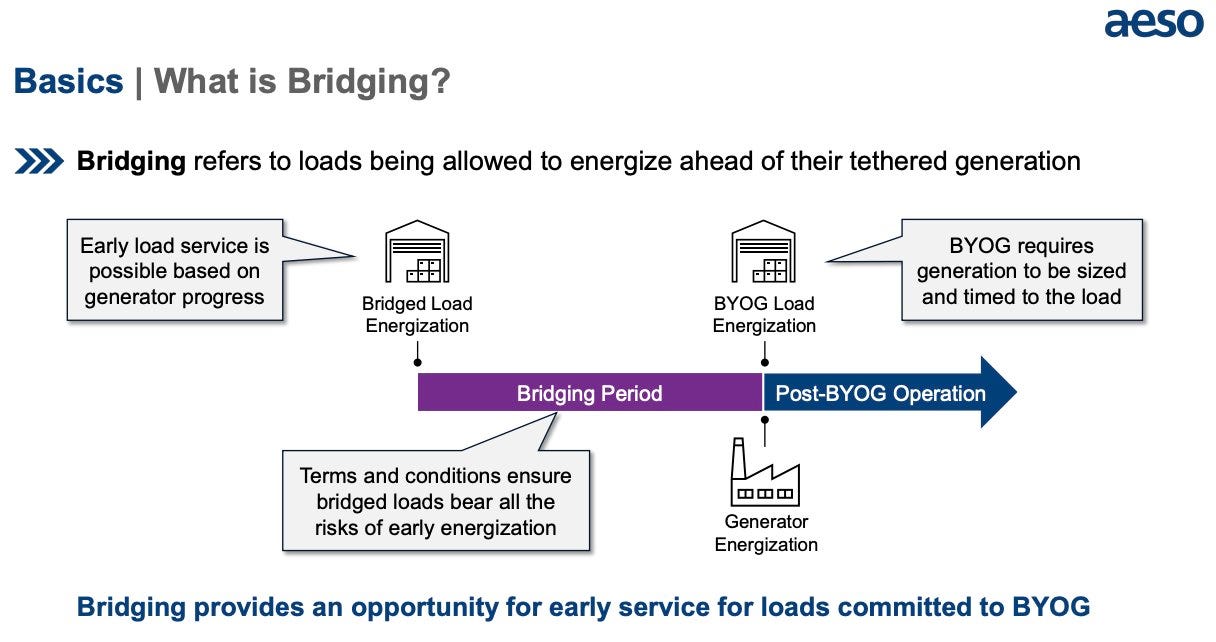
However, there was debate amongst industry participants in the AESO engagement session about whether a transitory program would attract investment in new generation.
“It’s really important that we have honest, evidence-based conversations about the impacts of these megaprojects and if [they’re] going to increase bills or not.”
The Alberta government released its framework for powering new data centres and is in the late stages of consultation with industry on the plan to offer up more power to data centres. The plan is expected to be finalized in August.
The province announced its artificial intelligence (AI) data centre strategy in 2024, and almost immediately there was a waiting list of new data centre proponents wanting connections to the electricity grid. So far, the grid operator has only approved two projects, allocating 1.2GW in total.
More than doubling the grid power available for data centres
CBC reports the two projects located just outside of Edmonton were selected late last year from a list of more than 35 data centres looking for connections to the grid. TransAlta’s Keephills gas power plant was given 230 MW to meet its ambitions for powering data centres, and Pembina Pipeline’s Greenlight Electricity Centre was allotted 970 MW.
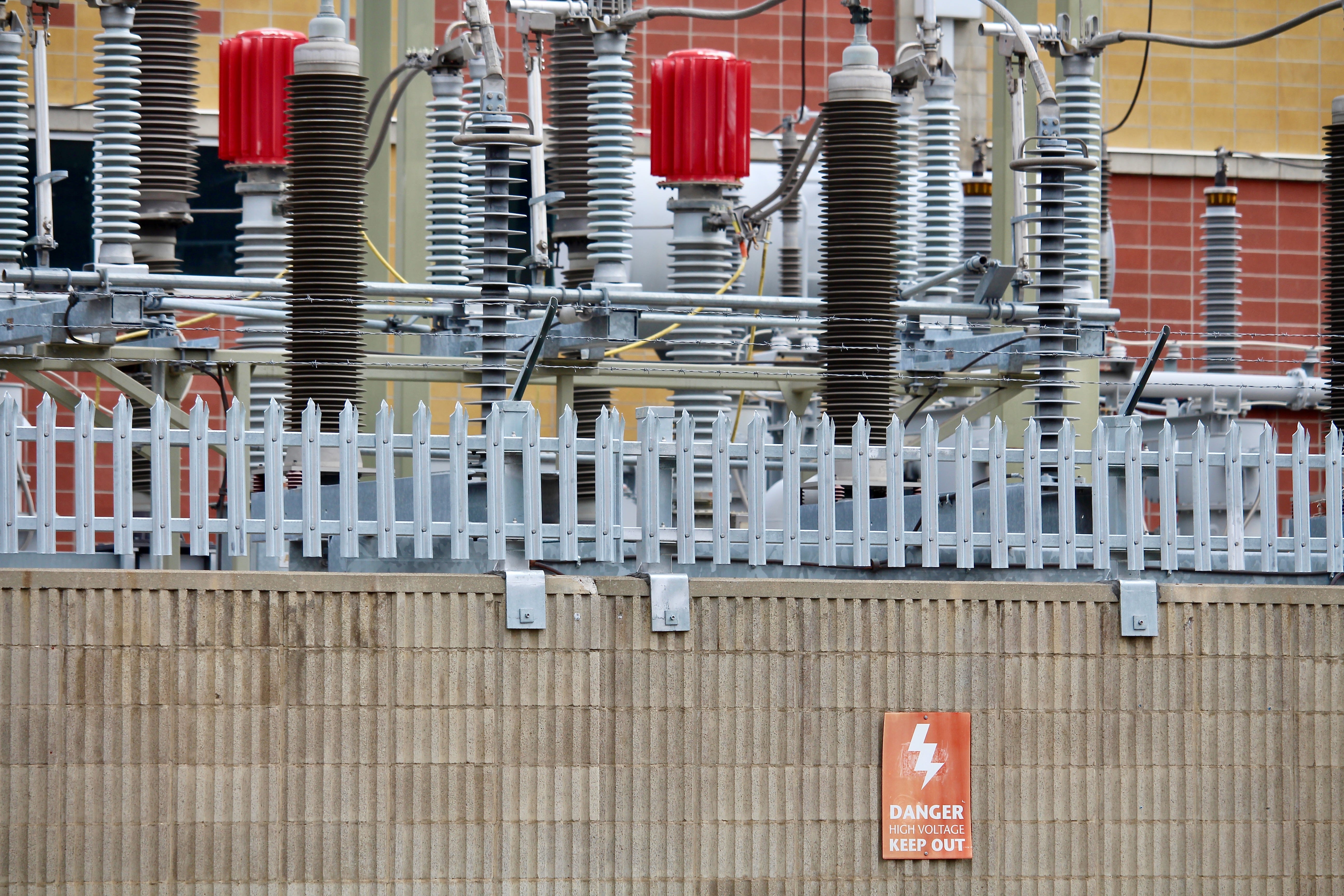
Greenlight made no secret that its power would be destined for data centres, and the Globe and Mail reported last year that Meta (Facebook) would be the customer, but the “tethering” of the two projects wasn’t fully revealed until recently. Tethering is a mechanism where projects requiring electricity from the grid are linked to generators providing grid-scale power for the purpose of requesting system access.
Meta confirmed the rumours this week that it will build a 1-GW “AI-optimized” data centre in Sturgeon County. The announcement followed Alberta Utilities Commission (AUC) approval of a 1.8-GW gas generation facility, meeting Alberta’s request that large data centres bring their own power.
In its first phase, Pembina, along with partners Morgan Stanley and Kineticor, will invest about C$4.6 billion to build generation to power Meta’s first data centre in Canada, estimated at another $13 billion. Meta will also invest $60 million in “local infrastructure improvements that will benefit the local community, and provide grants and funding to local nonprofits.”
Smith claims there will be a 6% decrease in transmission costs
In contrast to the AESO’s statement, Premier Danielle Smith claimed in a news release that “Alberta ratepayers will see up to [a] six per cent decrease on their electrical bill’s transmission costs” from the Greenlight Electricity Project, even though all its power will be required to run Meta’s data centre.
David Pickup, the Pembina Institute’s director of electricity, told The Mix that while it makes sense for the system operator to rethink how it gets projects moving forward and data centres connected quickly, there are ways to do it better.
“It’s really important that we have honest, evidence-based conversations about the impacts of these megaprojects and if [they’re] going to increase bills or not,” said Pickup.
(The Pembina Institute and Pembina Pipeline Corp. are unrelated organizations.)
Pickup said Pembina has been pushing for rules in the AESO framework that allow data centres to quickly ramp up while making sure they’re good neighbours, both in a local sense, but also within the systems in which they operate.
Glubish: ‘getting gas to market through ones and zeros‘
Alberta’s Technology and Innovation Minister Nate Glubish has consistently tied the AI data centre strategy with increasing gas production. He told a gathering of the Petroleum Technology Alliance Canada in Calgary in March that AI data centres are a way to bypass building pipelines, getting billions of cubic feet of gas to global markets “through ones and zeros, through fibre.”
Pembina Pipeline President and CEO Scott Burrows said in a news release the power project “represents a promising new growth platform, through which we are also helping to catalyze new natural gas demand that will provide additional benefits throughout our business.”
“Expanding dirty gas production to meet the tech sector’s skyrocketing demands amounts to a catastrophic attack on the rights of young people and future generations to a healthy environment.”
“If you’re starting from a position of ‘gas is the solution,’ without considering what is the best solution, they’re already going to be starting on the back foot,” Pickup said, adding that line of thought will likely lead to rising household electricity costs for Albertans for years to come.
“Adding a new power plant of this size—generating enough electricity to power a city two-thirds the size of Calgary—will massively increase demand for gas in the province,” Pickup said in a statement. “This, combined with Prime Minister Carney’s announcement [last week] that Canada intends to ‘triple’ LNG exports over the next decade, will expose Albertans to much more intense market competition for the gas they rely on heavily to heat their homes and power their grid.”
‘A disaster for future generations and the environment’
In a release Thursday, Amnesty International Canada called Meta’s plan to power its data centre with gas “a disaster for future generations and the environment.”
“Burning fossil fuels to meet our existing energy needs spells devastation on its own,” said Ketty Nivyabandi, secretary general of Amnesty’s English-speaking section. “Expanding dirty gas production to meet the tech sector’s skyrocketing demands amounts to a catastrophic attack on the rights of young people and future generations to a healthy environment. This must not be allowed to pass.”
Instead of “bring your own generation,” the Pembina Institute’s Kari Hyde, director of customer energy solutions argued in an opinion piece for Canada’s National Observer that data centres should be asked to bring their own flexibility.
“Data centres are not typical electricity users,” wrote Hyde. “Many can shift computing tasks to different times of day, manage cooling systems more strategically, use onsite storage or backup systems to reduce demand from the grid and lower electricity use when the system is under strain.”
With the right structures in place, large electricity users could “take responsibility not only for how they power their operations, but for how they interact with the grid,” she wrote.
Data centres on the grid drop 100’s of megawatts in an instant
A pair of reports from the non-profit Energy Systems Integration Group (ESIG) looked at how data centres, cryptocurrency operations, and other large loads behave differently, and can have a negative impact on grid reliability.
ESIG Chief Engineer Julia Matevosyan said in a news release that the first report looked at the unique characteristics and behaviours of these new grid participants, while the second explained why their behaviour matters for reliability.
“Both are important to grid planning and operations: understanding why an AI training cluster can drop hundreds of megawatts in an instant, and seeing how the grid is impacted by this as much as by a large generator loss,” said Matevosyan.
This story is part of The Energy Mix’s partnership with Small Change Fund.
Read the original version of the story at The Energy Mix
and subscribe - it’s also free!
Latest updates - Canada’s loan to support Meta’s data centre power plant
Export Development Canada provided a $100-200 million loan to the Greenlight power plant that will be used to power Meta’s data centre in Sturgeon County, Alberta.
“A recent investigation by Canada's National Observer found that some power companies expect electricity prices in Alberta to triple due to data centre demand. Meta's data centre plans to begin drawing electricity from the province's grid in 2028, two years before the Greenlight gas plant is expected to begin generating.”
Read more about the financing uncovered and reported by Canada’s National Observer.
AESO contradicted itself on slowing large load connections
Prior to publishing this story, the editorial team at The Energy Mix and I had a discussion about reporting on the information contained in the AESO video. The reason was that at the beginning of the video the host gave a warning to all participants in the online engagement session, including media, not to publish or report on anything said in the session. No one from The Mix was in attendance at the session. I discovered the video by following a link from another media outlet.
The video was posted publicly on AESO’s website not long after the session was held. We determined that the warning statement for participants was equivalent to an embargo that is sometimes placed on news releases to give reporters who agree to the embargo an early look at information so they can begin researching and writing ahead of the actual release. Once the video was posted publicly, the theoretical embargo ended since any member of the public can now view the video.
I’m glad we had the discussion and I want to thank the editorial team for agreeing to talk it through with me prior to publishing. ❤️
*****
Here are all of the questions I asked of AESO before writing this story, and their answers in full. In one case, they gave an answer that contradicted what was said in the video.
If AESO goes ahead with this plan, how will adding this new 1600 MW of bridging load impact affordability of electricity for everyday customers?
The AESO’s role is to ensure safe and reliable connection to the grid. The 1,600 MW limit on bridging load is anticipated to increase pool prices while reducing transmission costs. These market signals and the increase in demand are expected to attract new generation. Only projects that meet specific bridging qualifications can apply for a bridging contract and all bridged load remains fully interruptible if system reliability is at risk.
Will the addition of these bridging loads slow down the process for other more traditional large loads to connect to the grid?
No. The AESO’s proposed Bring Your Own Generation (BYOG) process is available to all large loads and presents a new path forward for loads choosing to add new supply to the grid.
Editor’s note - This answer is in contrast to the answer given in the AESO video from the engagement session. Paul Barry, executive director of the Industrial Power Consumers Association of Alberta grilled Chris Connoly of AESO about the impacts to other large load customers and eventually Connoly said, “Well, the fact is, if a request for a large load comes at the door right now, we will have to assess if the grid can adequately serve that load or not. And until the grid can develop some additional capacity, I would expect that those loads would proceed slower than they have historically.”
Has AESO seen the new reports by ESIG that detail the unique challenges data centres bring to the electricity grid?
July 6, 2026 -ESIG Reports Document Large Loads’ Behaviors and Capabilities - and What That Means for Grid Reliability as Demand Surges (Meta is a sustaining member of ESIG, by the way!)
Alberta’s data centre framework is being developed alongside technical requirements for data centres to ensure safe and reliable connections to the grid. The AESO recently released a Guide to AESO Connection Requirements for Transmission-Connected Data Centres, outlining the technical requirements and expectations for connecting large data centres to Alberta’s transmission system safely and reliably. These requirements also align with work underway by the North American Electric Reliability Corporation (NERC)’s Large Loads Working Group (LLWG) and other industry initiatives.
You can also see our Large Loads Projects page on aeso.ca and follow the Phase 2A: Large Load Integration | BYOG Process | AESO Engage project page for the latest updates and AESO initiatives around large load integration.
Will some of the challenges they identify be factored into grid stability given the push to respond to demand from data centres and, specifically in the bridging program being considered?
See Q3 (above).
NERC issued a Level 3 Alert in May due to data centres
“As the grid faces unprecedented challenges from a surge in large power consumers, NERC is taking significant steps to ensure the reliability of the bulk power system (BPS). NERC released a Level 3 Essential Action Alert, Computational Load Modeling, Studies, Instrumentation, Commissioning, Operations, Protection, and Control, outlining seven actions registered entities must implement to address immediate risks posed by computational loads interfacing with the BPS. The Level 3 Alert was issued as NERC observed customer-initiated large load reductions and significant oscillations that occur in seconds, leaving little or no room for real-time responses, threatening BPS reliability. The deadline for registered entities to submit their responses is August 3, 2026.”
Read more about the North American Electric Reliability Corporation’s (NERC) attempts to get the data centre situation facing utilities under control in the U.S.
Pickup: What Alberta is doing ‘doesn’t line up with best practices’
As with most interviews, I couldn’t fit everything that David Pickup of the Pembina Institute said into the story, but I’d like to highlight a few more detailed quotes that I thought were noteworthy.
“My issue is coming out with a statement that says, oh, we’re going to reduce bills in this way, providing a number, but not really providing any of that evidence behind it leads us to question the validity of it.”
“There’s some sort of initial results that people are seeing out of the U.S., where really the data centre boom has been going for a couple more years than up here in Canada. There’s examples to point to there.”
“Mr. Glubish talked about how they’ve been carefully watching and putting in place the rules that do protect consumers and make sure they’re doing it the right way (but) pushing these projects towards using gas, which they’re not using elsewhere to the same extent, is not necessarily aligned with that statement.”
“There’s a lot of rethinking happening at system operators of how do we get stuff moving forward quickly and connected, rather than a ‘first-come, first-served’ approach. And so, it makes sense in theory to have more flexible connection opportunities for things like data centres, particularly if they have some flexibility in how they operate, for example, or if they’re scaling up maybe from, you know, 100 megawatts to a gigawatt over the course of a few years.”
“Ultimately reliability is going to remain a pretty big challenge as a lot of the stuff comes on board.”
“Bringing your own generation is one thing, but for this example for this new one in Alberta (Greenlight and Meta) the data centre is connected to the grid and the power generator is connected to the grid as well. They’re next door to each other, so there’s maybe some opportunities there, but we really are talking about putting on the size of a city onto the grid very quickly and putting in generation to mitigate some of that. Ultimately reliability is going to remain a pretty big challenge as a lot of the stuff comes on board.”
“Again, none of this is an impossible to solve problems, but at the moment it’s just been - ‘get the stuff on the grid, scoop up all the grid connections, build massive gas plants’ without really consideration for how to do this in a better way. And I think that’s our overall concern.”
“There’s a way to do it that makes sense and the way that Alberta is doing it doesn’t really line up with best practices that we’re seeing across the world.”
Further media reporting on this topic:
includes a prediction that Meta’s data centre could scale up to as much as 6GW
Facebook has registered lobbyists in Alberta “seeking to engage the government of Alberta law and policy governing the development of facilities for advanced computing.”
All photos by me.
Musical selection for this post: