
O’Leary’s AI Data Centre Projects Face Backlash On Both Sides of The Border
Appeared originally in The Energy Mix - June 3, 2026, with unanswered questions, national security connections, and Kevin O'Leary won an AI Ambassador award!

I am grateful to be writing this newsletter from Moh’kinstis, and the traditional Treaty 7 territory of the Blackfoot confederacy: Siksika, Kainai, Piikani, as well as the Îyâxe Nakoda and Tsuut’ina Nations. The Treaties were an agreement to share the land and must be honoured. I support land back as an act of reconciliation. Lands inhabited by Indigenous peoples contain 80% of the world’s remaining biodiversity. Indigenous Peoples’ traditional knowledge systems are critical to creating a more harmonious future for all. My Scottish/Irish ancestors were immigrants who travelled by ship to the east coast in the late 1700’s or early 1800’s. We arrived uninvited on the traditional unceded territory of the Wəlastəkewiyik (Maliseet) whose along with the Mi’Kmaq / Mi’kmaw and Passamaquoddy / Peskotomuhkati Tribes / Nations had signed Peace and Friendship Treaties with the British Crown in the 1700s. As a child in the 1970’s, my parents moved the family west to work in the oil sands and I spent my teen years growing up in Treaty 8 territory, the traditional lands of the Denesuline and Cree People.
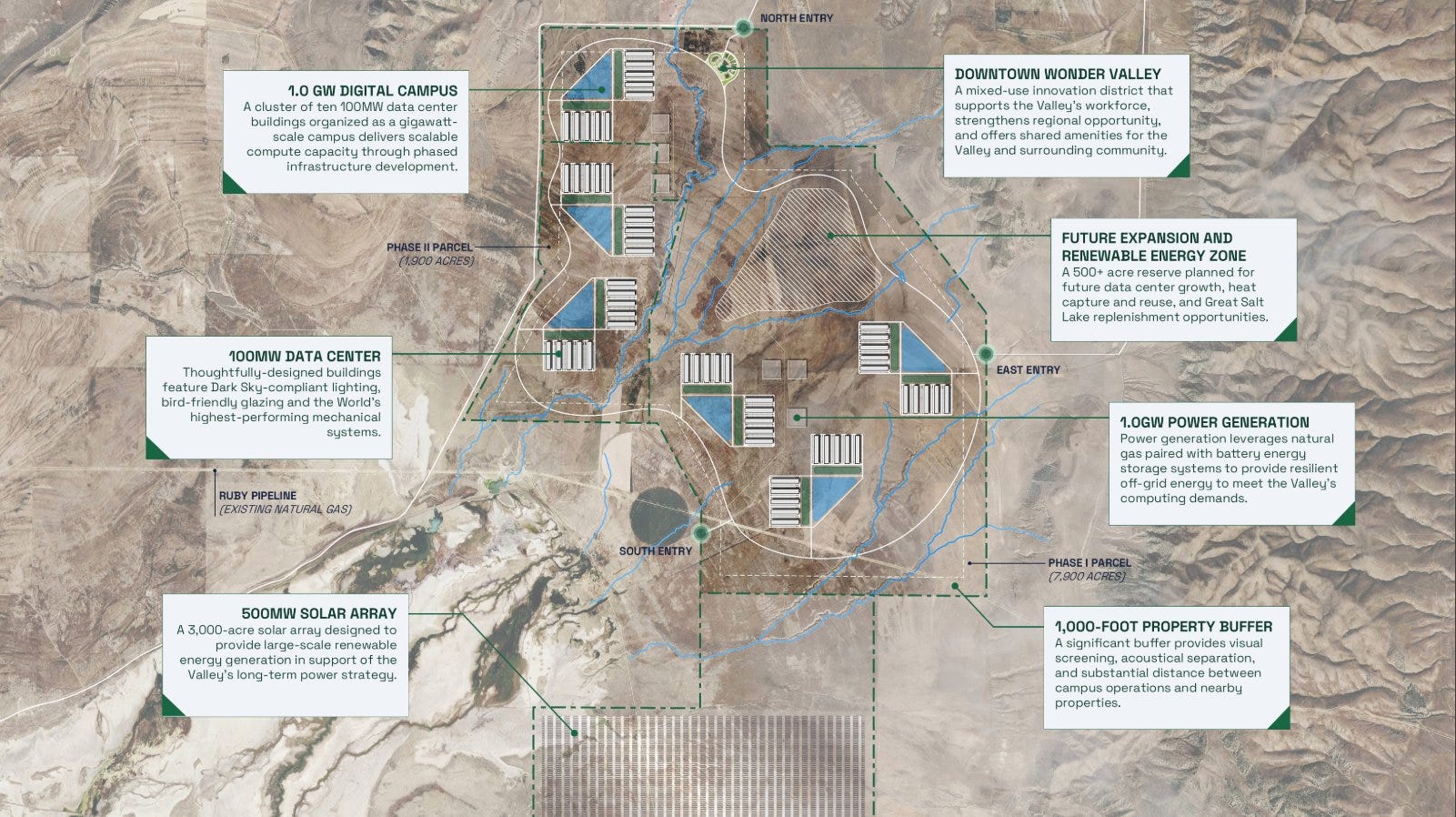
Two Utah lawmakers are walking back their once unbridled support for celebrity investor Kevin O’Leary’s Stratos Project, a proposed 9-gigawatt artificial intelligence (AI) data centre near the Great Salt Lake, as opposition grows and a midterm election approaches.
Utah Senate President Stuart Adams is demanding O’Leary reduce the footprint of the project by 75%, shrinking it from 40,000 to just 10,000 acres (16,200 to 4,050 hectares) and include more environmental protection and transparency measures.
“Utah can pursue economic opportunity while protecting our water, air, wildlife, and communities,” Adams said in a statement. “We can and must do both.”
Adams added that he wrote a letter to O’Leary asking him to find ways to reduce water consumption, add water to the Great Salt Lake after treatment, and take steps to work with state officials on land conservation. To reduce concerns about heat from the computer servers being unleashed on the surrounding landscape, he called for the project to include heat-capture technologies.
Experts told the Salt Lake Tribune the heat from the project would have “devastating consequences” for wildlife, plants, and the fertility of other ranchland in the Hansel Valley.
One of Adams’ challengers in this month’s Republican primary election, attorney Stephanie Hollist, said the senator’s actions are “too little, too late” and that he should have engaged with the public earlier. She wants the data centre approval process paused until the impacts are fully understood.
U.S. jurisdictions that once provided aggressive economic incentives to attract data centres are now pivoting, found researchers at the University of Virginia who reviewed more than 700 federal, state, and local data centre policies across the country. They are repealing or tightening tax exemptions and mandating temporary pauses until regulations can be drafted.
At least 20 moratoria have been proposed at the local, state, and federal levels, and local governments are increasingly using zoning ordinances to restrict data centres.
Application for referendum denied, politicians feeling pressure
Activists in Utah are skeptical of Adams’ about-face. He is a voting member of the Military Installation Development Authority (MIDA), which is partnering with O’Leary to develop the project and advocated on behalf of the developer in compensation negotiations with Box Elder County.
“The only reason Adams is sending the letter is to help his upcoming re-election campaign,” Brenna Williams, lead liaison for the Box Elder County Accountability Referendum (BEAR) campaign, told ABC4 Utah News. “Indivisible Utah is running a postcard campaign against him so I’m sure he’s feeling pressure.”
“there’s no question, the process was not good.”
Utah Governor Spencer J. Cox
Williams is currently appealing a ruling in Utah’s First District Court against her group’s two applications for a referendum on the Stratos project.
“We care deeply about this community and will fight to protect it from those who seek to do it harm,” Williams said in a news release following the May 28 court decision.
Adams was among several politicians O’Leary praised in a release announcing the data centre in February. He also named Governor Spencer J. Cox and Utah senators Mike Lee and John R. Curtis, saying that “projects of this magnitude require disciplined execution and close collaboration with state and local leadership.”
Opponents rallied at the state capital and delivered a letter to Cox with more than 6,000 signatures urging him to take “binding action” to preserve the Great Salt Lake, reports Grist.
Raising Utah’s carbon emissions by 64%
O’Leary has claimed outside interests are funding the protesters and spreading false information about the development.
Cox said the rollout of the Stratos Project was handled poorly, telling reporters “there’s no question, the process was not good.”
He issued an executive order to “raise the bar” for data centre development in the state, announcing a new framework to address issues such as air quality, water, wildlife, utility costs, and transparency to “ensure that data center development aligns with Utah’s long-term interests and reflects Utah values.”
Cox also recently told the Salt Lake Tribune that although the first phase of the project would be gas-powered, future phases should include “nuclear, geothermal, solar, and other technology.”
Logan Mitchell, a climate scientist and analyst with Utah Clean Energy, calculated that a 9-GW gas power plant would produce about 35 million tonnes of carbon emissions each year and could raise Utah’s emissions by about 64%.
Water has been the other big concern. Without explanation, O’Leary withdrew a second application for a water permit for the project last week. The first application received thousands of formal protests before it was withdrawn, and the second one saw nearly 700 objections, reported ABC News4Utah.
In his statement, Adams also demanded that O’Leary improve transparency by developing a public-facing website hosting information about all Stratos Project approvals and permits. O’Leary’s original website includes information about both the Stratos project—originally named Wonder Valley—and a nearly identical data centre project planned for northern Alberta, also called Wonder Valley.
A new website dedicated to Stratos has been launched, stating that the project’s “future phases are expected to include additional sources beyond gas-fired generation.” The type of energy will “depend on regulatory approvals, technology availability, and infrastructure development at the time of each phase.”
Data Centre Opposition Mounts in Alberta
With controversy still swirling in Utah, O’Leary is holding an open house June 4 in a small hamlet near his proposed AI data centre and power plant in Alberta.
A citizen petition to the House of Commons initiated in Red Deer, Alberta, calls for a “federal moratorium on the approval, construction, expansion, or operation of proposed hyperscale AI data centres in Alberta.” It names Wonder Valley and another hyperscale data centre proposed in Olds, Alta. by the Synapse Real Estate Group. The petition is sponsored by NDP Member of Parliament Heather McPherson.
Sign the petition here. Initiated by Flora Mejia from Red Deer, Alberta
Concerns about the Wonder Valley project were a focus of a virtual town hall hosted last week by Public Interest Alberta, a public sector advocacy group. Among the speakers was Melanie Sachs, a Maine state representative, who described her efforts to legislate a moratorium on data centres in Maine. The law passed the House and the Senate with bipartisan support, only to be vetoed by Governor Janet Mills.
Sachs told attendees that data centre planning is often done behind closed doors and that communities need to be proactive in asking questions of the government before it’s too late.
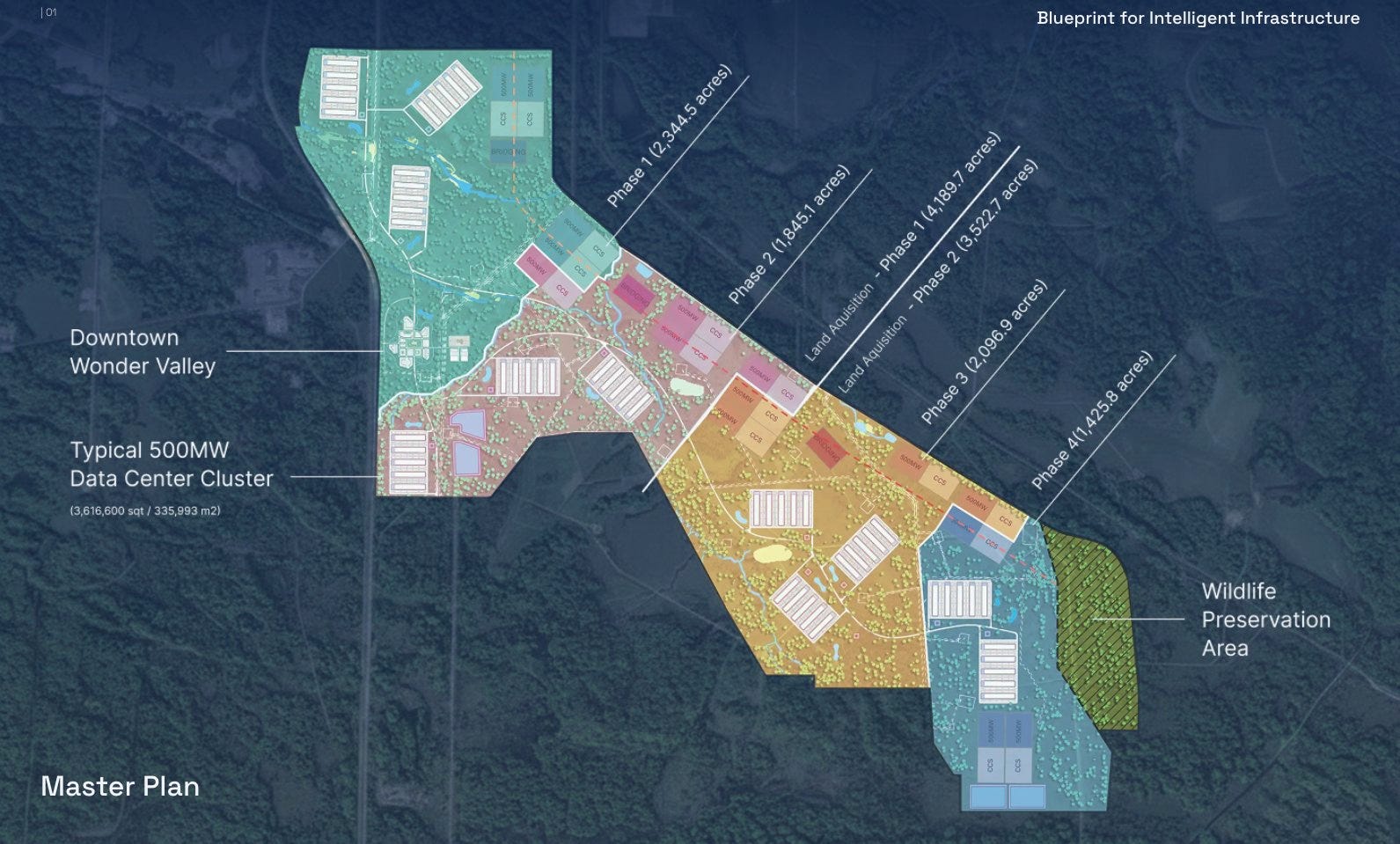
The Municipal District of Greenview, which will host the Wonder Valley project and has been working closely with O’Leary since 2024, has spent about C$70 million so far preparing the site for industrial development. When The Energy Mix asked whether the municipality was concerned about the Utah controversy spilling over into Canada, Manager of Communications and Marketing Stacey Sevilla said the district “did not have any additional information to provide.”
She did not answer questions about concerns the data centre may be used by the U.S. military, as is the case with the Utah project, or questions about data sovereignty.
Construction to begin in Alberta in 2027
Greenview issued its first newsletter about the project, indicating O’Leary is planning to begin construction sometime in 2027.
The Mix also reached out to O’Leary’s contact email for the upcoming open house in Grovedale with questions about water, battery energy storage, plans for carbon capture, and gas supply arrangements, but did not receive a response.
Alberta’s Premier Danielle Smith is promoting an AI data centre strategy aimed at attracting $100 billion in investment by offering tax breaks to companies that supply their own power. The province is aiming to double its gas production by powering new data centres, but a prominent energy analyst told The Mix the strategy’s focus on gas, while restrictions on renewables remain in effect, could “kill the data centre industry they’re hoping to create.”
In Alberta too, questions are surfacing about the transparency of decision-making around major data centre developments. The Office of the Information and Privacy Commissioner is investigating whether the Premier’s office met the “duty to assist” standard after The Mix’s Access to Information request returned no documents related to Kevin O’Leary, his company and co-founder Carl Agren, Kyle Reiling or Tyler Olsen from the MD of Greenview, and/or The Phoenix Group UAE (United Arab Emirates).
O’Leary’s $70-billion Wonder Valley data centre is so far nearly identical to Utah’s, with demand for 7.5 GW of power at full buildout. It’s also located in a drought-stricken area that has declared an agricultural disaster the last two summers. The project would use anywhere from 6 to 24 million cubic metres of water, covering a smaller area of nearly 65 square kilometres, and produce as much as 30 megatonnes of emissions annually, depending on what technology and mitigation measures are used.
Read the original version of the story, part of The Energy Mix’s ongoing investigative series, Hidden Wonder Valley.
Lots of unanswered questions about Wonder Valley in Alberta
There was no reply to my questions sent to the wondervalleyengagement@aimlandandenviro.ca email address advertised for the open house on June 4.
What will be the total annual water usage (in cubic metres) of the project (including the power plant) in Phase 1 and at full build-out?
What type of energy storage system will the project have?
What will the carbon emissions be in Phase 1 and at full build-out? When will carbon capture be integrated into the project?
What type of turbines will be used and how many? Will there be backup diesel generators? Is there a gas supply agreement in place yet?
Stacey Sevilla, Manager, Communications and Marketing for the Municipal District of Greenview did not answer any of my detailed questions. She encouraged me to contact O’Leary Digital (who never replies to any of my emails).
Opposition to the Utah project has become a major issue for Mr. O’Leary and taking a similar adversarial approach here in Alberta now seems like a risk. What is the MD planning to do to ensure this doesn’t happen here?
Does the MD of Greenview have a concern about Canada’s data sovereignty with regards to its dealings with Mr. O’Leary on the Greenview project, given that he is closely connected with US President Donald Trump?
With Mr. O’Leary working so closely with the Pentagon and the US on data centres, will there be any data sovereignty requirements imposed by the municipality on the Wonder Valley project?
Will the Wonder Valley Alberta AI compute centre be used by the Pentagon or the US military?
More national security connections on O’Leary’s team
I’ve written previously about the military connections of several people in O’Leary’s orbit, including company co-founder Carl Agren, but the executive team has expanded to include several new people that caught my eye.
Ashley Davis is the new special advisor for government affairs. Davis is the former special assistant to the Secretary of Homeland Security, Tom Ridge, under President George W. Bush’s administration. Davis was working for the administration on 9/11.
According to her LinkedIn profile Davis is sought after for her insights on national security, foreign policy, and US politics. She co-founded a company that merged with S-3 Group in 2025 becoming one of the largest lobbying firms in Washington, DC.
She also posted a week ago that Kevin O’Leary was given an award by the Washington AI Network honouring him with the AI Global Ambassador award for his “work in Utah and Alberta, Canada.”

O’Leary was there alongside a who’s who of the Trump White House, including Energy Secretary Chris Wright, Medicare and Medicaid Administrator, Dr. Mehmet Oz, and Commerce Secretary Howard Lutnick. The event was organized by Tammy Haddad, socialite and owner of Haddad media consultancy. O’Leary was recognized for “his investments in AI implementation, data centers, and the convergence of AI with blockchain and digital payments, and for advocating AI literacy to ensure future job security.”
And of course there’s a Musk connection
David Rossi is the new Director of Procurement & Logistics for O’Leary Digital, and he was formerly the head of technology sourcing and supply chain at Elon Musk’s xAI primarily responsible for Colossus supply chain management and procurement, albeit for only about six months.
Before that, he was head of technology sourcing and supply chain for X.com for three years. He also worked for Salesforce and Apple.
According to his LinkedIn profile Rossi currently works for InPwr Inc. since February 2026, a company founded by Brian Inskeep, who is also apparently now on the O’Leary executive team.
I’ve written about the Colossus data centre(s) in Memphis, Tennessee and the controversies surrounding the building of the centres, which support the Grok platform.
There’s a lawsuit before US courts right now with the National Association for the Advancement of Colored People (NAACP) arguing Colossus was built illegally and endangers the lives of Black communities nearby.
Now, Trump’s Department of Justice has intervened to try and stop the lawsuit.
Justice Department attorneys are calling for the lawsuit against xAI to be dismissed, arguing Grok’s continued operation is a “matter of paramount national security,” and that the NAACP’s complaint “threaten[s] artificial intelligence innovation, plus the energy needed to power it.”
“The NAACP’s attempt to cut off the power that supports Grok also threatens national security because … Grok provides critical support for the Department of War’s military operations,” the Justice Department wrote in court documents filed Monday. (source: the Independent)
Another new face on the website is Justin Baker, Director of Project Management, who used to be Chief Operating Officer for Gaylor Electric until late 2024. A search turned up a court case between Baker and his former company.
Watch for my next post where I’ll have photos and details from the Wonder Valley open house held in Grovedale, Alberta.

The musical selection for this post: (dancing)