Community Pushback Blocks $64B in U.S. Data Centre Development
Appeared originally in The Energy Mix on July 13, 2026, with added charts, graphs, and nature photos

I am grateful to be writing this newsletter from Moh’kinstis, and the traditional Treaty 7 territory of the Blackfoot confederacy: Siksika, Kainai, Piikani, as well as the Îyâxe Nakoda and Tsuut’ina Nations. The Treaties were an agreement to share the land and must be honoured. I support land back as an act of reconciliation. Lands inhabited by Indigenous peoples contain 80% of the world’s remaining biodiversity. Indigenous Peoples’ traditional knowledge systems are critical to creating a more harmonious future for all. My Scottish/Irish ancestors were immigrants who travelled by ship to the east coast in the late 1700’s or early 1800’s. We arrived uninvited on the traditional unceded territory of the Wəlastəkewiyik (Maliseet) whose along with the Mi’Kmaq / Mi’kmaw and Passamaquoddy / Peskotomuhkati Tribes / Nations had signed Peace and Friendship Treaties with the British Crown in the 1700s. As a child in the 1970’s, my parents moved the family west, where my dad began work for a tar sands company and I spent my teen years growing up in Treaty 8 territory, the traditional lands of the Denesuline and Cree People. As an adult, I worked as a journalist, and later left journalism to work in communications for three decades. Now, I’m back doing investigative reporting, always keeping truth and reconciliation at the forefront of my journalism.
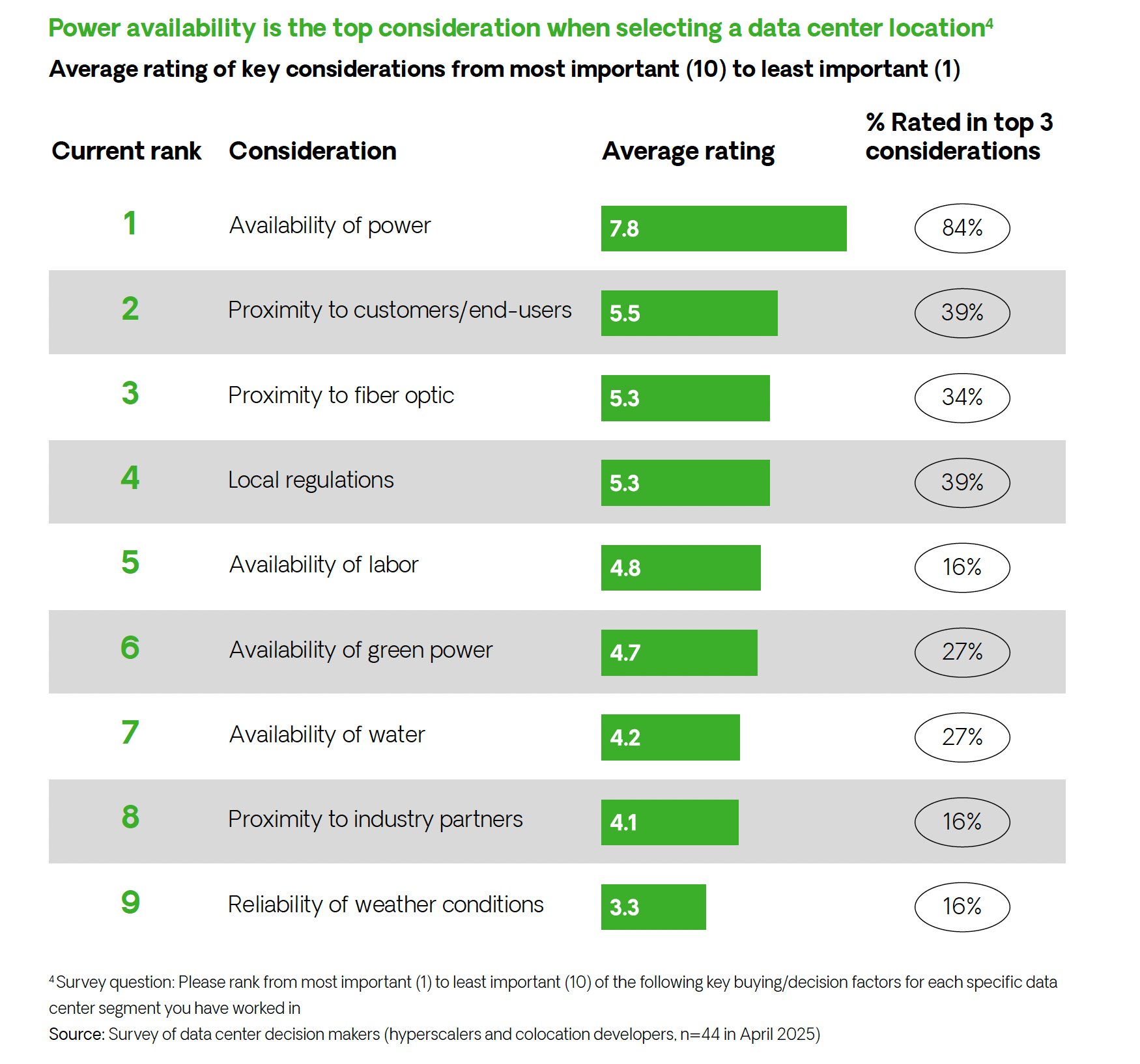
Community opposition blocked or delayed US$64 billion of data centre projects in the United States in less than a year, yet community concerns do not make the top-four list of considerations for data centre proponents when they pick a location.
Bloom Energy, a California-based multinational that specializes in onsite fuel cell power systems, conducted a survey of 156 data centre decision-makers, and reviewed public announcements and conversations with industry leaders.
The survey found that power availability remains the biggest challenge to industry growth plans, though community scrutiny of rising electricity prices, water consumption, and grid reliability has become the second biggest barrier to development.
Bloom Chief Marketing Officer Natalie Sunderland said in a news release that “solutions that reduce strain on local infrastructure while helping developers bring new capacity online faster—such as clean onsite power—will play an important role” in moving future projects forward.
The report authors suggest “a disconnect between engagement efforts and community priorities.”
“We believe the winners in the next phase of AI buildout will be those that can grow in a way that works for both operators and the communities that host them.”
The report finds that developers deal with a long list of objections rather than a single issue. The top three are rising electricity prices, water consumption, and grid reliability. Other issues include traffic and construction disruption, limited local economic benefits, carbon emissions, land use and visual impact, noise, and air quality.
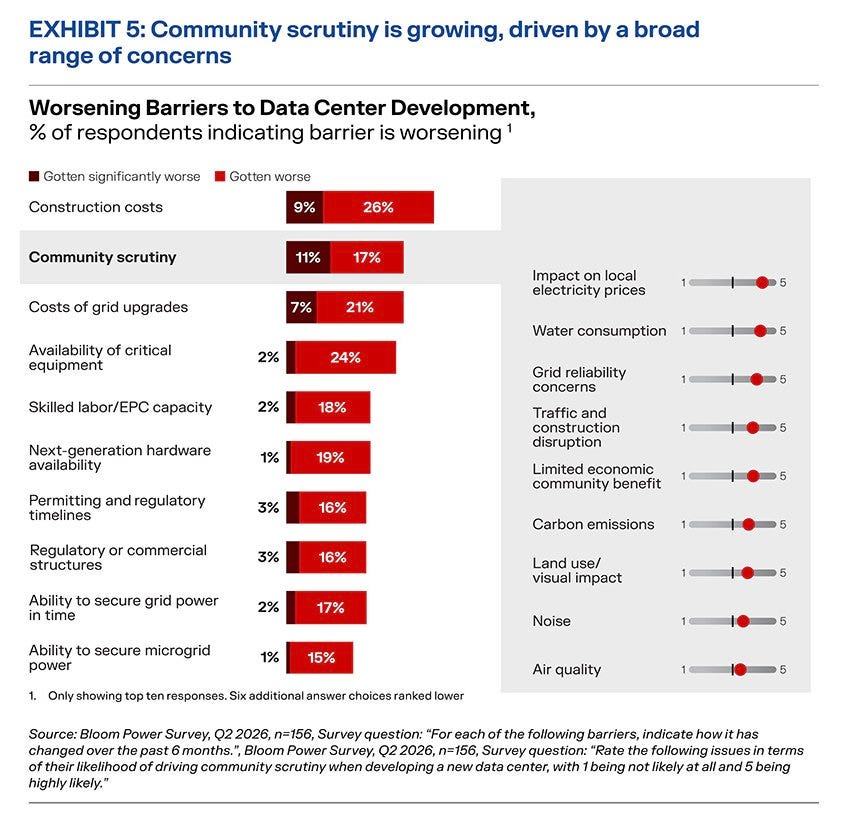
However, only about half of the data centre decision-makers surveyed said they were holding public forums or investing in local initiatives, while recent national polling shows that only 33% of developers are addressing grid reliability, and only 29% are responding to water consumption concerns. The report authors suggest “a disconnect between engagement efforts and community priorities.”
74 new data centres = 140 million new car and truck emissions
About 61% of respondents said they would rather deploy onsite power, usually fossil gas, than relocate to a site with power, but only about one-third of those U.S. data centre projects are expected to incorporate carbon capture, utilization, and storage (CCUS), projected to grow to more than 40% by 2035.
“In their wholehearted embrace of dirty and outdated gas power, data centre developers are announcing to the public that they don’t care about us.”
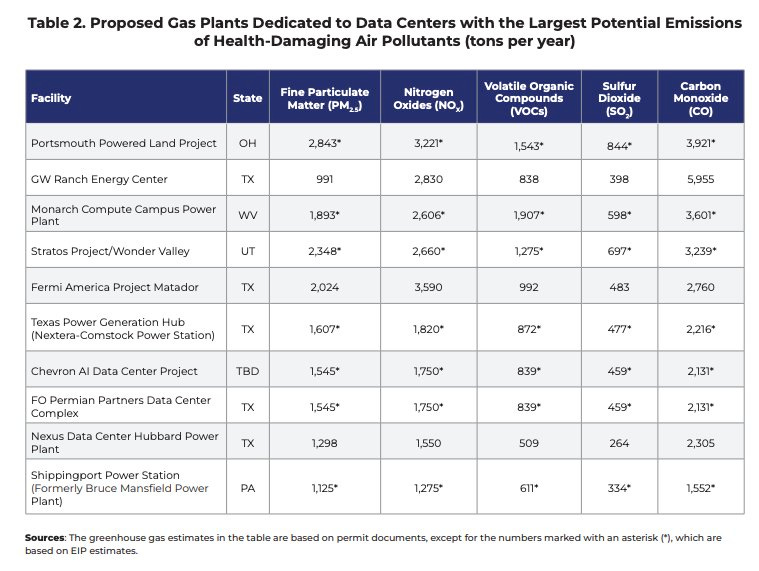
Another report, authored by the Environmental Integrity Project (EIP), found at least 74 gas-fired power plants on tap to provide energy for data centres across the U.S. would release nearly 662 million tons per year of greenhouse gas pollution, equal to 140 million cars and trucks driving for a year.
S&P Global estimated in 2024 that the clamour for electricity from data centres could increase gas demand by up to 170 million cubic metres per day by 2030, which would mean even more emissions from leaks and the operation of facilities such as new pipelines, processing plants, and storage facilities.
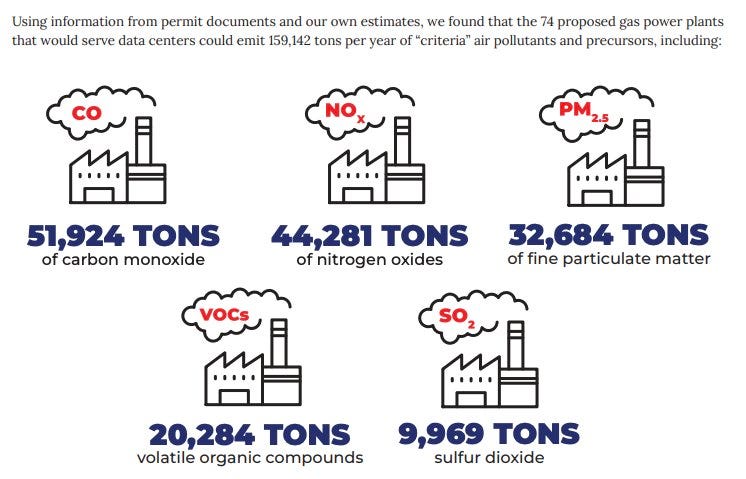
EIP reported that 89% of the power plants are slated for low-income communities already saddled with pollution and premature death and would worsen public health by releasing 159,142 tons a year of air pollutants, including 44,281 tons of nitrogen oxides that contribute to smog and lung damage, and 32,684 tons of fine particulate matter, which can trigger heart and asthma attacks.
Communities “deserve better than decades of toxic pollution, parched streambeds, and climate chaos,” Clean Air Council Executive Director Alex Bomstein said in a news release.
“In their wholehearted embrace of dirty and outdated gas power, data centre developers are announcing to the public that they don’t care about us.”
Most water consumption for data centres is from the power plants
Water consumption was one of the top three community concerns identified in the Bloom report, and EIP found that power plants use between 75-92% of all the water needed to keep data centres running. More than half of the water used in data centres comes from potable water supplies and two-thirds of U.S. data centres in the last four years have been built or planned in water-stressed regions, according to EIP.
“Water conservation and better location planning are important to protect public water supplies from this thirsty industry,” the Bloom report’s authors wrote.
At the time the Bloom Energy report was released in June, at least 18 state bills and 86 local moratoriums were proposed across the U.S., while industry was forecasting more than a doubling of data centre power demand by 2030, to between 700 and 1,200 trillion watt hours (TWh).
“NERC observed customer-initiated large load reductions and significant oscillations that occur in seconds, leaving little or no room for real-time responses, threatening bulk power system reliability.”
The Electric Power Research Institute Inc., a non-profit energy research and development organization, reported in its 2026 projection that U.S. data centres could double or even triple their power consumption to 9–17% of the nation’s electricity by 2030, compared to the 4-5% it uses now.
NERC issued a Level 3 Alert due to data centre threats to reliability
Access to power is the number one concern for data centre developers as the demands for more intense computing power increase. The “inference” work, where a trained machine learning model draws conclusions from brand new data, now uses more than half of overall artificial intelligence computing power required.
Power for “training,” or showing examples of desired inputs and outputs, is not being displaced, but is growing alongside inference, according to the Bloom Energy report.
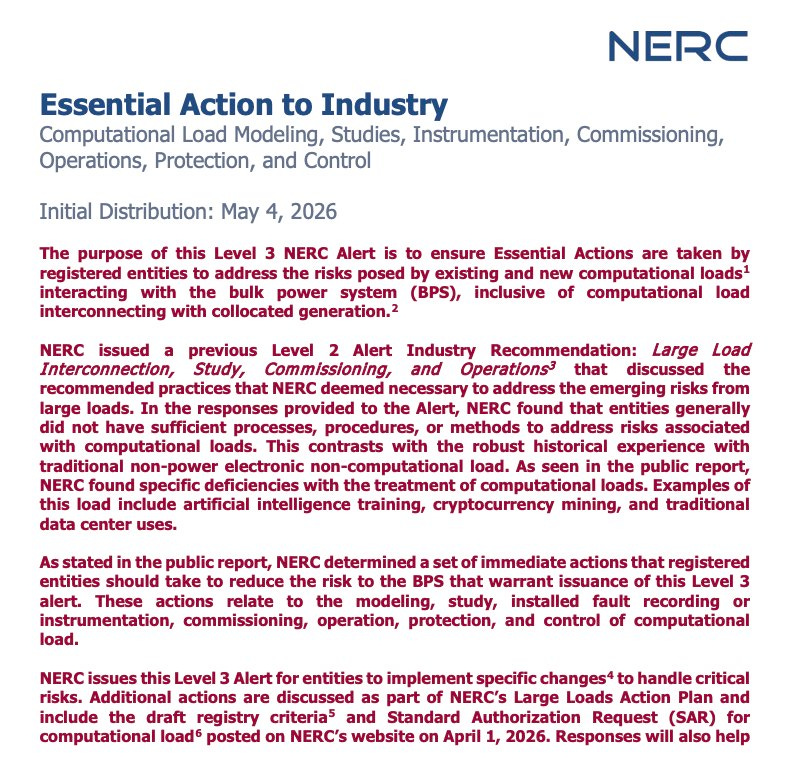
In May, the North American Electric Reliability Corporation (NERC), a not-for-profit, international regulatory authority, issued a Level 3 Alert, its highest alert rating, asking utilities to take action to “address immediate risks posed by computational loads interfacing with the bulk power system, threatening reliability.” Computational loads include AI training, cryptocurrency mining, and traditional data centre uses.
“NERC observed customer-initiated large load reductions and significant oscillations that occur in seconds, leaving little or no room for real-time responses, threatening bulk power system reliability,” NERC wrote in a statement that called the challenge to the grid “unprecedented.” Registered utilities have until August 3 to submit their responses to the NERC, although the request is non-binding.
Read the original version of the story at The Energy Mix
and subscribe - it’s also free!