
ICYMI: O’Leary’s Data Centre Will Be One of Earth’s Largest Heat Sources, Physicist Warns
Appeared originally in The Energy Mix - June 5, 2026, with photos from the open house posters, and details on the questions no one wanted to answer

I am grateful to be writing this newsletter from Moh’kinstis, and the traditional Treaty 7 territory of the Blackfoot confederacy: Siksika, Kainai, Piikani, as well as the Îyâxe Nakoda and Tsuut’ina Nations. The Treaties were an agreement to share the land and must be honoured. I support land back as an act of reconciliation. Lands inhabited by Indigenous peoples contain 80% of the world’s remaining biodiversity. Indigenous Peoples’ traditional knowledge systems are critical to creating a more harmonious future for all. My Scottish/Irish ancestors were immigrants who travelled by ship to the east coast in the late 1700’s or early 1800’s. We arrived uninvited on the traditional unceded territory of the Wəlastəkewiyik (Maliseet) whose along with the Mi’Kmaq / Mi’kmaw and Passamaquoddy / Peskotomuhkati Tribes / Nations had signed Peace and Friendship Treaties with the British Crown in the 1700s. As a child in the 1970’s, my parents moved the family west to work in the oil sands and I spent my teen years growing up in Treaty 8 territory, the traditional lands of the Denesuline and Cree People.
Alberta’s Wonder Valley artificial intelligence (AI) data centre and nine-gigawatt power plant will be “one of the largest single-site heat sources on the planet” when fully operational, warns a Utah State University physicist commissioned to assess the project.
“These are not data centres in any familiar sense of the term,” wrote [pdf] Dr. Robert Davies, a physicist and complex systems scientist, in an assessment for the Sturgeon Lake Cree Nation. “From here on, I’ll refer to these energy-and-heat behemoths—massive compute fused with massive power generation—as Gigascale AI Smelters, smelting data and material strip-mined from people and planet.”
At a realistic generation efficiency for a gas plant, Davies said supplying 9 GW of electricity would mean “burning fuel at a continuous rate on the order of 16 to 18 GW, day and night, year-round.”
“Essentially the entire fuel burn ends up as heat released at the site, because the electricity is consumed onsite and degrades, in full, to heat.”
The project is planned for approximately 65 square kilometres owned by the Municipal District of Greenview, including Crown land transferred to them in a series of purchase agreements. A plot that size would fit about 130 West Edmonton Malls.
“The data centre won’t be introducing a single novel disturbance into intact boreal forest,” he wrote. “Rather it will be layering an enormous new thermal, acoustic, air-emissions, and water demand on top of an environment already fragmented by resource extraction—across territory in which the Cree Nation exercises Treaty and harvesting rights.”
“From here on, I’ll refer to these energy-and-heat behemoths—massive compute fused with massive power generation—as Gigascale AI Smelters, smelting data and material strip-mined from people and planet.” Physicist Dr. Robert Davies
Because numerous companies are already extracting resources from the area, creating “dense access networks through the surrounding forest,” Davies said cumulative effects studies should be done and a “whole systems analysis” is needed.
‘Everything is connected,’ yet project exempted from an EIA
Wonder Valley is proposed in a region struggling with drought conditions, about 460 kilometres north of Edmonton, near Grande Prairie, Alberta, sitting on one of the world’s largest gas deposits, the Montney Formation.
“Everything is connected: feedback loops in complex systems like this mean effects of one kind generate other effects of other kinds,” Davies wrote.
Sturgeon Lake Cree Nation called for a federal impact assessment of Wonder Valley, which is planned on its territory and Treaty 8. The federal Impact Assessment Agency did not respond to The Energy Mix’s request for comment.
Alberta’s Environment and Protected Areas (AEPA) department gave the project an exemption from an environmental impact assessment, a process that would have studied cumulative impacts. The Alberta government recently signed an agreement with the federal government to allow the province to take more of a lead on environmental assessments, though it was overwhelmingly opposed by Indigenous groups.
“This is a massive project with significant emissions, water use and, most alarming, creates a ‘heat island’ [effect] in an area already ravaged by wildfire, drought, and climate change,” said [Facebook] Chief Sheldon Sunshine.
AEPA Minister Grant Hunter did not immediately respond to The Mix’s questions about regulations around data centres and how cumulative effects of the project would be studied.
No regulations specific to data centres exist
Nathan Ip, NDP shadow minister for Technology and Innovation, told The Mix that Alberta doesn’t have specific regulations for AI data centres, “which is precisely the problem.”
“Data centres, like all major projects, will have lasting effects on nearby communities, which is why we need clear regulations, strong safeguards, and proper oversight in place,” said Ip.
He added that growth must be done responsibly “due to the impacts on water use, energy demand, heat, and noise that aren’t fully addressed by existing industrial regulations.”
The Sturgeon Lake report was released the same day that O’Leary Digital held its first community open house in Grovedale, a small hamlet near Wonder Valley.
The company did not reply to The Mix’s question about whether it would apply for a federal environmental impact assessment.
“fighting through noise and fragments of information to try and understand a project that is going to change this region for decades throughout generations.” Grande Prairie resident, Casey Klein
Dozens attended the open house to ask questions of O’Leary CEO Paul Palandjian and find out more about the project.
Casey Klein, a mother and student who drove from Grande Prairie with her six-year-old son to attend the event, told The Mix “the open house really didn’t settle any of my concerns, it deepened them, if anything.”
She found herself “fighting through noise and fragments of information to try and understand a project that is going to change this region for decades throughout generations.”
“The open house itself felt like a warning because it was crowded, it was loud, it was hard to navigate, and hard to hear people,” Klein said, pausing before finding the correct word to describe the event.
“Disrespectful, that’s it.”
O’Leary challenging the duty to consult in court
Ret Louise, another Grande Prairie resident, posted her concerns on Facebook after attending the open house, asking “why should anyone trust what Kevin O’Leary says?” Louise added that ordinary Albertans are left bearing the risks of billionaires granted approvals without Indigenous consultation.
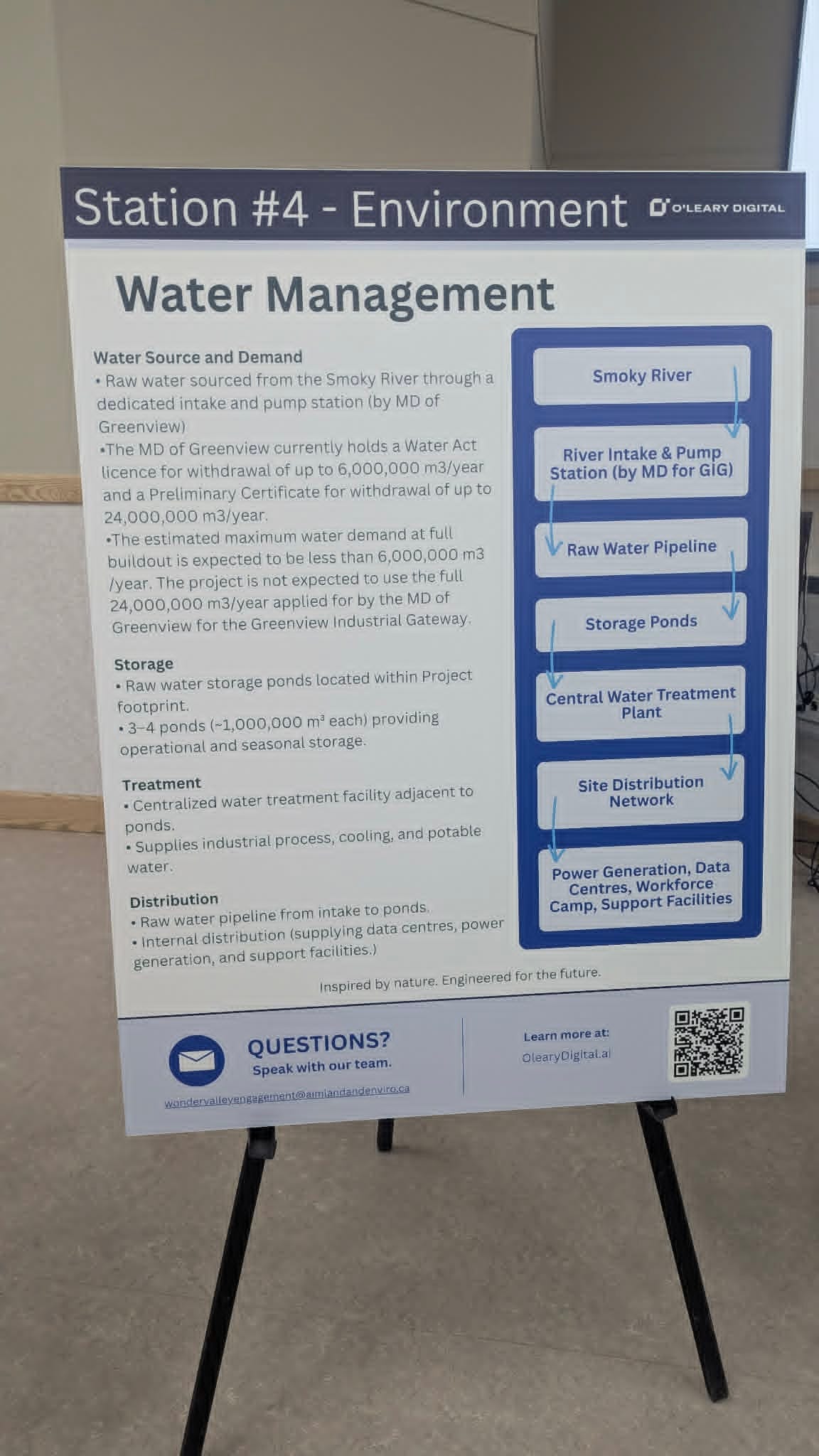
She emphasized the need to protect water resources and air quality, mitigate impacts to wildlife, and align major projects with the province’s long-term interests. Sturgeon Lake is preparing to argue in court that the Crown failed to uphold its duty to consult with the First Nation in granting a water licence for Wonder Valley. O’Leary is challenging the Nation’s assertion the municipality had a duty to consult.
Canada’s National Observer reports that documents show O’Leary’s company signed a land sale contract with Greenview that allows them to back out from the project if the local government can’t secure the necessary water licences.
Read the original version of the story, part of The Energy Mix’s ongoing investigative series, Hidden Wonder Valley.

More unanswered questions about Wonder Valley, Alberta
After receiving the full news release and report from Sturgeon Lake Cree Nation, I emailed the federal Impact Assessment Agency with the following questions:
Has O’Leary’s team submitted a request to the IAAC for a decision on an environmental impact assessment yet?
The First Nation has also released a preliminary report on the heat effects of such a project and the need for a cumulative effects assessment. However, the Alberta government has already exempted the project from such an assessment. Does the recent agreement with Alberta on impact assessments mean that the federal government won’t do an EIA?
Do you have a comment in response to the First Nation’s request that the federal government conduct an EIA?
Three days after the story appeared, I finally heard back from the federal government. This was their response, which only directly addressed one of my three questions:
Apologies for the delay in response.
Under the Impact Assessment Act (the IAA), a federal impact assessment may be required if a project meets the criteria set out in the Physical Activities Regulations (the Project List). The Project List focuses on projects with the greatest potential to cause adverse effects in areas of federal jurisdiction (e.g., impacts on fish and fish habitat, migratory birds, federal lands, or Indigenous Peoples). (my emphasis - see below)
The Impact Assessment Agency of Canada (IAAC) is responsible for conducting impact assessments of these designated projects.
The impact assessment process under the IAA officially begins when IAAC accepts a proponent’s Initial Project Description. O’Leary Digital Limited, the proponent of Wonder Valley AI Data Centre Park, has reached out to IAAC.
However, IAAC has not received an Initial Project Description for the project.
If O’Leary Digital Limited submits an Initial Project Description, IAAC would then determine, in accordance with the IAA, whether a federal impact assessment is required.
They suggested I read a media guide on the process and told me to contact O’Leary Digital with any specific questions about the project. O’Leary has never responded to an email I’ve sent them in more than 18 months, but oh well.
One thing to note is that Wonder Valley is near a designated Important Bird Area (IBA) for the Trumpeter Swan. It’s the reason Grande Prairie is known as “Swan City.” This should, in theory, bolster the case for a federal impact assessment.
I also contacted Alberta’s Environment and Protected Areas Minister Grant Hunter, by emailing his press secretary, and asked the following questions:
Does the Alberta government have specific regulations relating to AI (hyperscale) data centres which have unique environmental impacts (ie. heat, noise, water)?
If not, how does the government plan to regulate the project in order to protect the environment and the health and safety of individuals living in the area?
Will the cumulative effects of the mega-project be studied in an area with a significant amount of industrial development already?
I still have not received an email acknowledgement or any reply.
Even though they never reply, I submitted a few questions to O’Leary Digital:
Have you submitted a request to the Impact Assessment Agency of Canada for a decision on a federal environmental impact assessment yet? (this was sent before I received confirmation from the Impact Assessment Agency)
Sturgeon Lake Cree Nation released a preliminary report on the heat effects of such a project and the need for a cumulative effects assessment. Do you have a comment in response to the First Nation’s request or the preliminary report?
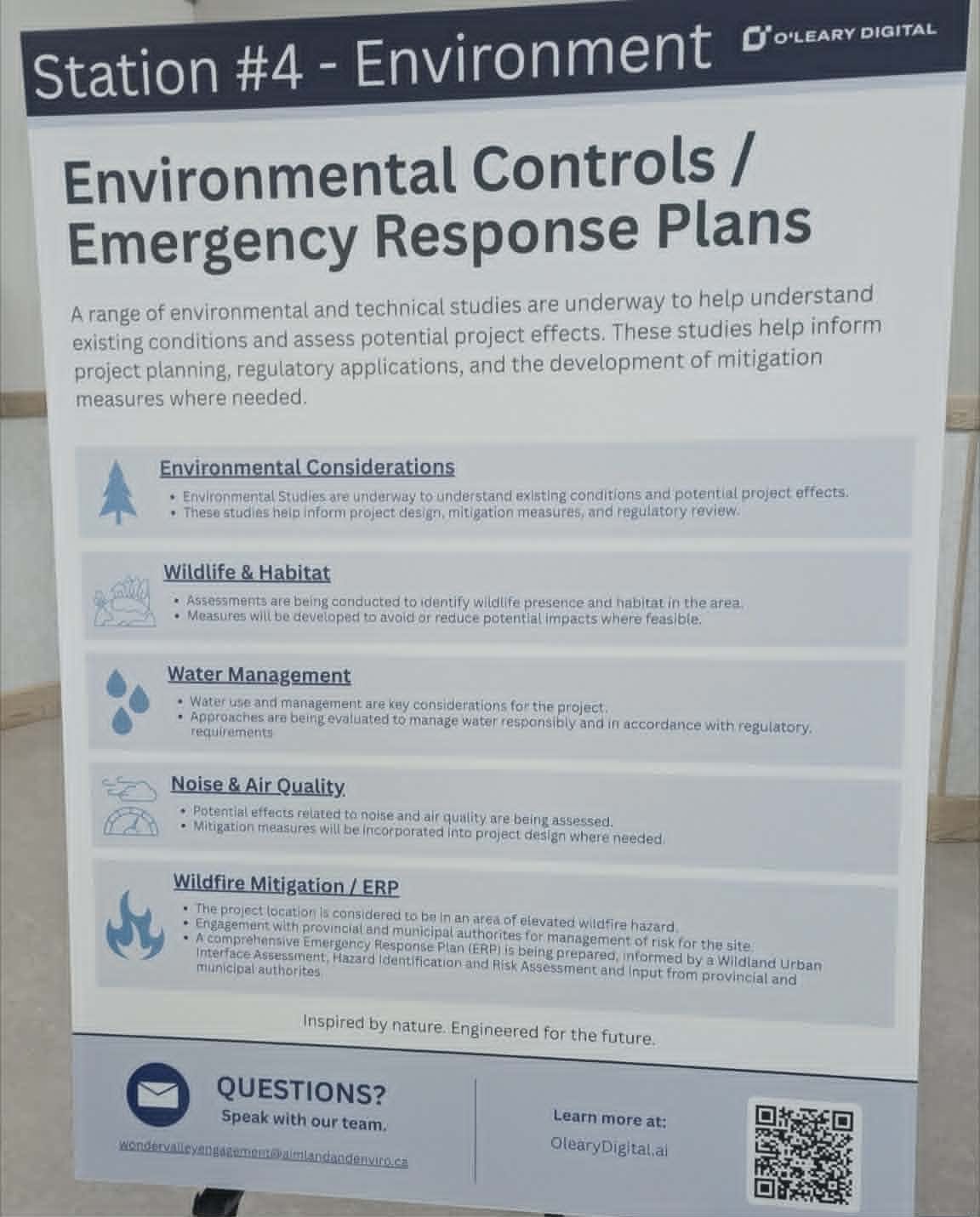
And again, I tried submitting questions to the email address listed on the poster boards at the open house (as I did the week earlier, for my previous article):
Gensler claims the project is “designed to capture and sequester 100% of carbon from on-site natural gas power generation,” and “the project dramatically reduces operational emissions at an unprecedented scale.”
What is the carbon capture plan for Wonder Valley?
What does it mean on the O’Leary website when it says the project will have “Carbon-capture-ready power generation”?
No big surprise, they did not acknowledge my email or reply with any answers to my questions.
More documents to review
I’ve just received a boatload of new documents to review relating to Wonder Valley. Stay tuned to The Energy Mix and this Substack newsletter to find out whether anything new is revealed.
Musical selection for this post: